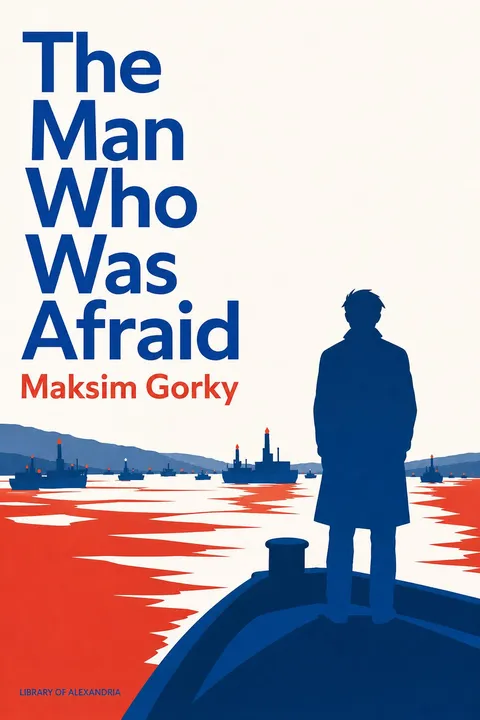
The Man Who Was Afraid
Russian Literary Fiction of Wealth, Rebellion, and a Life Without Purpose
Report an issue
Tell us what's wrong and we'll take a look.
Thanks – we got it. We'll review and follow up if needed.
He inherits a fortune, but cannot discover what to live for. On Russia's Volga River, a merchant's son turns his unease into a rebellion he cannot control.
In The Man Who Was Afraid, Maksim Gorky follows Foma Gordyeeff, heir to the shipping business built by his formidable father, Ignat. Where Ignat meets life with appetite and determination, Foma finds doubt. Neither business, drink, nor love can reconcile him to a world in which profit seems to justify almost anything. His sharp-minded godfather, Mayakin, understands the rules of that world; Foma increasingly refuses to accept them.
Set among river steamers, prosperous households, taverns, and the laborers who sustain the merchants' wealth, the novel brings provincial Russian society into vivid focus. Gorky gives his troubled protagonist both moral insight and destructive impulses: Foma can recognize hypocrisy without knowing how to build a different life. That tension makes this more than a story of privilege rejected. It is a searching examination of what happens when conscience awakens without direction, and why opposition alone may not be enough to give a life meaning.
What readers find inside:
- A divided heir - Foma struggles with the distance between his inherited position and his uncertain desires.
- Fathers and mentors - Ignat's forceful example and Mayakin's calculating outlook reveal competing lessons in power and survival.
- Life on the Volga - Ships, commerce, and hard physical labor shape the novel's social world.
- Wealth and conscience - Merchant prosperity stands beside deprivation, sharpening Foma's anger at the society around him.
- Rebellion without a path - Acts of defiance expose both the force of Foma's protest and the limits of his vision.
For readers of Russian classics, psychologically complex fiction, and novels about class and belonging, this is an unsettling encounter with a man who cannot make peace with his place in the world.
Enter Gorky's riverfront world and follow an inheritance that becomes a crisis of conscience.
Maksim Gorky
Alexei Maximovich Peshkov, better known as Maxim Gorky, was a renowned Russian and Soviet writer and a strong advocate for socialism. Born on March 28, 1868, in Nizhny Novgorod, Russia, he became one of the most prominent figures in Russian literature during the late 19th and early 20th centuries. Gorky's works often reflected his deep concern for the oppressed and his belief in social justice, which made him a leading figure in the socialist movement. His literary contributions include novels, plays, and short stories that critiqued social inequality and the human condition. Gorky was nominated five times for the Nobel Prize in Literature, a testament to his influence and the impact of his writing. His personal life included a marriage to Yekaterina Peshkova, from 1896 to 1903, though he later separated from her. Maxim Gorky spent his later years in Gorki-10, Russia, where he died on June 18, 1936, at the age of 68. His legacy as a writer and a proponent of socialist ideals continues to be a significant part of Russian literary history.
More by Maksim Gorky


Why Readwise Books?
Readwise Books is an ebook & audiobook platform that automatically logs how much you and your friends read, making it fun and easy to read more. Learn more →