Report an issue
Tell us what's wrong and we'll take a look.
Thanks – we got it. We'll review and follow up if needed.
This work has been selected by scholars as being culturally important, and is part of the knowledge base of civilization as we know it. This work was reproduced from the original artifact, and remains as true to the original work as possible. Therefore, you will see the original copyright references, library stamps (as most of these works have been housed in our most important libraries around the world), and other notations in the work.
This work is in the public domain in the United States of America, and possibly other nations. Within the United States, you may freely copy and distribute this work, as no entity (individual or corporate) has a copyright on the body of the work.
As a reproduction of a historical artifact, this work may contain missing or blurred pages, poor pictures, errant marks, etc. Scholars believe, and we concur, that this work is important enough to be preserved, reproduced, and made generally available to the public. We appreciate your support of the preservation process, and thank you for being an important part of keeping this knowledge alive and relevant.
Ferdinand Gregorovius
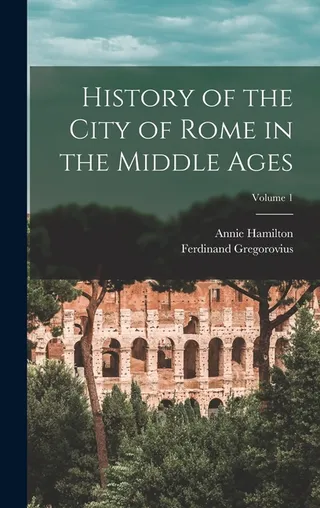
Ferdinand Gregorovius was a German historian, born on January 19, 1821, in Nidzica, Poland, and is best known for his work on the medieval history of Rome. Gregorovius developed a deep interest in the city of Rome and its historical significance, dedicating much of his career to exploring its medieval past. His most renowned work, History of the City of Rome in the Middle Ages, is a comprehensive study that spans several volumes and provides a detailed examination of the city's political, cultural, and religious developments during the medieval period. Gregorovius's scholarship is characterized by a thorough analysis of primary sources and a keen understanding of the historical forces that shaped Rome's evolution. His works also include studies on key figures in Roman history, such as Lucrezia Borgia: Daughter of Pope Alexander VI, which highlights his interest in the intricate lives of historical personalities. Throughout his career, Gregorovius was recognized for his intellectual rigor and contributions to historical research. He passed away on May 1, 1891, in Munich, Germany, leaving behind a legacy of important historical writings that continue to influence the study of medieval Rome and its role in European history.
More by Ferdinand Gregorovius



Why Readwise Books?
Readwise Books is an ebook & audiobook platform that automatically logs how much you and your friends read, making it fun and easy to read more. Learn more →