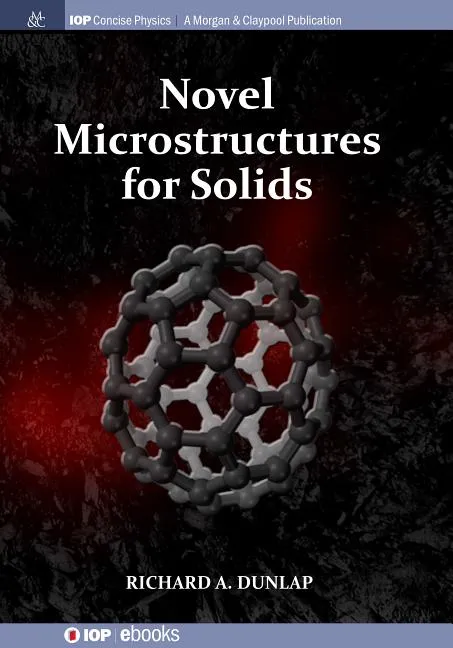
Novel Microstructures for Solids
Report an issue
Tell us what's wrong and we'll take a look.
Thanks – we got it. We'll review and follow up if needed.
For many years, evidence suggested that all solid materials either possessed a periodic crystal structure as proposed by the Braggs or they were amorphous glasses with no long-range order. In the 1970s, Roger Penrose hypothesized structures (Penrose tilings) with long-range order which were not periodic. The existence of a solid phase, known as a quasicrystal, that possessed the structure of a three dimensional Penrose tiling, was demonstrated experimentally in 1984 by Dan Shechtman and colleagues. Shechtman received the 2011 Nobel Prize in Chemistry for his discovery. The discovery and description of quasicrystalline materials provided the first concrete evidence that traditional crystals could be viewed as a subset of a more general category of ordered materials.
This book introduces the diversity of structures that are now known to exist in solids through a consideration of quasicrystals (Part I) and the various structures of elemental carbon (Part II) and through an analysis of their relationship to conventional crystal structures. Both quasicrystals and the various allotropes of carbon are excellent examples of how our understanding of the microstructure of solids has progressed over the years beyond the concepts of traditional crystallography.








Why Readwise Books?
Readwise Books is an ebook & audiobook platform that automatically logs how much you and your friends read, making it fun and easy to read more. Learn more →