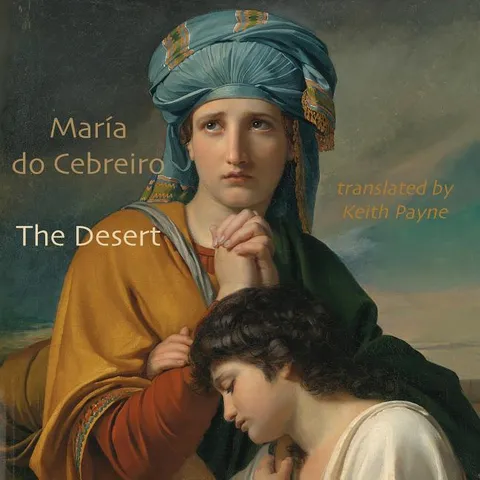
The Desert
Report an issue
Tell us what's wrong and we'll take a look.
Thanks – we got it. We'll review and follow up if needed.
"The majority of these poems exist thanks to a convalescence that lasted half a year and that, like the practice of Hesychasm, forced me to become quiet, solitary and silent.
In the writing of this book I was very inspired by the audio-visual piece Et la guerre est à peine commencée (And the war has only just begun), from Tiqunn Collective, who I had first heard about thanks to the publisher and philosopher Roberto Abuín. The voice-over in the film recalls the profound but unstable connection between the world's will to distance, and the creation of community. The first hermits set out alone but eventually found each other in the middle of the desert. As we learn from Deleuze, nomadism is not a refutation of the centre, but the recognition that life moves and we need to be quick to catch it." --María do Cebreiro
Maria Do Cebreiro
María do Cebreiro is a widely-acclaimed Galician-language poet and critical theorist. Her published poetic works include: O estadio do espello [The Mirror Stage] (1998), Nós, as inadaptadas [Us, the Maladapted] (2002), Non queres que o poema te coñeza [You don't want the poem to know you] (2004), Os hemisferios [Hemispheres] (2006), Cuarto de outono [Autumn Room] (2008) and Non son de aquí [I am not from here] (2008). As an academic she has published As antoloxías de poesía en Galicia e Cataluña: representación poética e ficción lóxica (2004), As terceiras mulleres (2005), and a variety of articles where new theoretical perspectives for contemporary Galician studies are explored.
More by Maria Do Cebreiro
Keith B Payne
Translated by
Keith B. Payne, president of the National Institute for Public Policy, adjunct professor at Georgetown University, editor-in-chief of Comparative Strategy, and a member of the State Department's Defense Trade Advisory Group, is the author of seven previous books on international security issues.


Why Readwise Books?
Readwise Books is an ebook & audiobook platform that automatically logs how much you and your friends read, making it fun and easy to read more. Learn more →