Report an issue
Tell us what's wrong and we'll take a look.
Thanks – we got it. We'll review and follow up if needed.
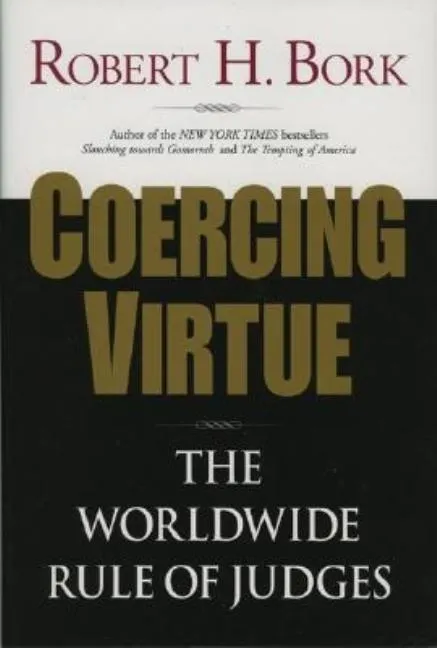
In general, courts have been activist in opposing majority views on such matters as sexual practices, secularism versus religion, rights of speech and expression and feminism. This judicial activism appears to impinge on the legitimate domains of the executive and legislative branches of government and constitutes the judicialization of politics and morals. According to Bork, a number of courts tend to act in this activist fashion. As well, international tribunals appear to exceed their jurisdiction, posing a threat to national sovereignty just as the national courts threaten democratic government. This activism is more than a threat; Bork argues that both sovereignty and self-government have already been seriously damaged. Coercing Virtue attempts to account for the phenomenon of why so may courts in democratic nations behave in an imperialistic manner and why the results almost always appear to advance the liberal political and cultural agenda.
Robert H Bork
Robert H. Bork has served as Solicitor General and Acting Attorney General of the United States, and as a United States Court of Appeals judge. A former professor of law at Yale Law School, he is currently a professor at Ave Maria School of Law, a Senior Fellow at the American Enterprise Institute, and the Tad and Dianne Taube Distinguished Visiting Fellow at the Hoover Institution. Also the author of the bestselling The Tempting of America, he lives with his wife in McLean, Virginia.
More by Robert H Bork






Why Readwise Books?
Readwise Books is an ebook & audiobook platform that automatically logs how much you and your friends read, making it fun and easy to read more. Learn more →