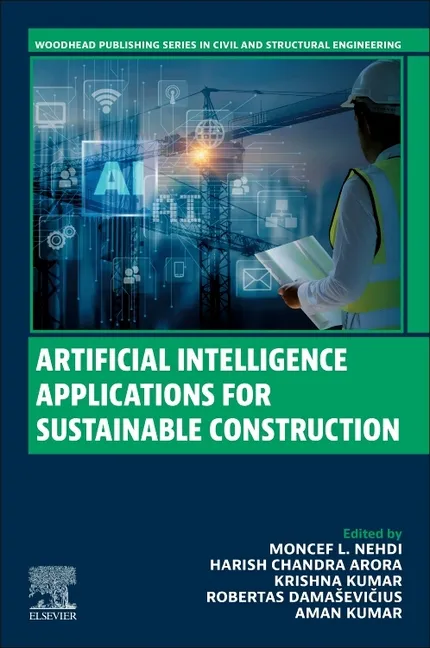
Artificial Intelligence Applications for Sustainable Construction
Report an issue
Tell us what's wrong and we'll take a look.
Thanks – we got it. We'll review and follow up if needed.
Artificial Intelligence Applications for Sustainable Construction presents the latest developments in AI and ML technologies applied to real-world civil engineering concerns. With an increasing amount of attention on the environmental impact of every industry, more construction projects are going to require sustainable construction practices. This volume offers research evidence, simulation results, and case studies to support this change. Sustainable construction, in fact, not only uses renewable and recyclable materials when building new structures or repairing deteriorating ones, but also adopts all possible methods to reduce energy consumption and waste.
The concisely written but comprehensive, practical knowledge put forward by this international group of highly specialized editors and contributors will prove to be beneficial to engineering students and professionals alike.
Moncef L Nehdi
Dr. Nehdi joined the University of Guelph as Dean, College of Engineering and Physical Sciences (CEPS) in September 2024. An experienced academic leader, Nehdi served as Chair of the Department of Civil Engineering, McMaster University. Prior, Nehdi was a Professor in the Department of Civil and Environmental Engineering at Western University from 2007 to 2021. Nehdi is an award-winning researcher and educator in sustainable civil engineering, particularly cement and concrete research, sustainable construction and the application of AI in materials and structures research. He has written more than 500 research publications and was listed by Elsevier and the Shanghai Global Ranking in the world's most impactful civil engineers. Nehdi received his B.A.Sc. from Laval University and M.A.Sc. from Sherbrooke University, and holds a PhD from the University of British Columbia, all in civil engineering. He is a fellow of the Canadian Academy of Engineering, the Engineering Institute of Canada, the American Concrete Institute, the Canadian Society for Civil Engineering, and the Asia Pacific Artificial Intelligence Association.
Harish Chandra Arora
Dr. Harish Chandra Arora currently holds the esteemed position of Principal Scientist in the Structural Engineering Group at CSIR-Central Building Research Institute in Roorkee, India. With a distinguished career spanning more than 29 years, Dr. Arora is a renowned figure in the field of structural engineering. Dr. Arora is also functioning as an Associate Professor in the Academy of Scientific and Innovative Research (AcSIR), Ghaziabad, India. His contemporary research areas include structural composites, structural corrosion, distress diagnosis, seismic evaluation, repair and retrofitting of structures and machine learning applications in structural engineering, etc. Dr. Arora's exceptional contributions to the field have garnered recognition in both national and international academic journals. Beyond his scholarly achievements, he has made a significant impact on the education and development of future engineers, having supervised and guided over 100Þ students in their pursuit of bachelor of technology and master of technology degrees. Additionally, he continues to mentor and support research scholars pursuing doctoral programs at the Central Building Research Institute in Roorkee, India.
Furthermore, Dr. Arora actively contributes to the scholarly community as a reviewer for journals published by Springer Nature and Elsevier. His commitment to maintain the quality and rigor of academic publications is highly regarded. Beyond his academic pursuits, Dr. Arora has undertaken numerous consultancy and research and development projects within the field of structural engineering, further showing his dedication to advancing the science and practice of sustainable construction.
Krishna Kumar
Dr. Krishna Kumar (Member, IEEE) has more than 14 years of experience in Renewable Energy Development. He is presently a researcher at the Department of Water Resources Engineering and Center for Advanced Middle Eastern Studies at Lund University, Sweden. He holds a PhD in Renewable Energy. He worked as a postdoctoral research fellow at the School of Electrical and Electronics Engineering in the Rolls-Royce Corporate Lab, Nanyang Technological University, Singapore, from February 2023 to March 2024. Prior to that, he worked as a Senior Engineer at UJVN Ltd. (A State Government PSU of Uttarakhand (India)) from January 2013 to February 2023. His expertise includes the design, installation, commissioning, testing, and operation & maintenance of hydro, solar, and wind power plants. Dr. Kumar has also served as an Assistant Professor/Lecturer on the term appointment basis at Kumaon Engineering College, Dwarahat, Uttarakhand (India); Bharat Institute of Technology, Meerut (India); and Uttaranchal Institute of Technology, Dehradun (India), for more than three years. Dr. Kumar has published numerous highly cited SCI/SCIE research articles in reputed journals. He has also authored/edited 12 books with publishers such as Elsevier, Wiley, Taylor & Francis, Springer, and River Press. His current research interests include Renewable Energy, Multiphase Machines, Electrical Equipment Health Monitoring Systems, AI/ML, and data science.
Robertas Damasevičius
Prof. Robertas Damasevičius received his PhD degree in Informatics Engineering from the Kaunas University of Technology, Lithuania, in 2005. He is currently a Professor in the Department of Applied Informatics, Vytautas Magnus University, Lithuania, and the Department of Software Engineering, Kaunas University of Technology, Lithuania, as well as an Adjunct Professor at the Faculty of Applied Mathematics, Silesian University of Technology (Poland). He lectures courses on human-computer interaction design, robot programming, and software maintenance.
He is the author of more than 500 peer-reviewed articles and a monograph published by Springer. His research interests include assisted living, medical imaging, and medical diagnostics using explainable artificial intelligence and robotics. He is also the Editor-in-Chief of Information Technology and Control journal. He has been a Guest Editor of several invited issues of international journals, such as BioMed Research International, Computational Intelligence and Neuroscience, the Journal of Healthcare Engineering, IEEE Access, IEEE Sensors, and Electronics.
Aman Kumar
Aman Kumar holds a Master's degree in Construction Technology and Management from the National Institute of Technical Teachers' Training and Research, Chandigarh, and a Bachelor's degree in Civil Engineering from I.K. Gujral Punjab Technical University, Jalandhar. He is currently pursuing a PhD at McMaster University, Hamilton, Canada. Before that, Kumar was a Project Associate at the CSIR - Central Building Research Institute, Roorkee, India. He also accrued practical experience by covering a variety of roles in industry, including as a Structural Health Monitoring Engineer with Aimil Ltd., New Delhi, and as a Quality Control Engineer with Ambuja Cements Ltd., Chandigarh. Aman has also served as an Assistant Professor at the Indo-Global College, Punjab, where he taught earthquake engineering, estimation & costing, and concrete technology. His professional expertise spans non-destructive testing (NDT), structural health monitoring, fiber-reinforced polymers, fiber-reinforced cementitious matrices, and AI and ML applications for structural engineering.


Why Readwise Books?
Readwise Books is an ebook & audiobook platform that automatically logs how much you and your friends read, making it fun and easy to read more. Learn more →