Report an issue
Tell us what's wrong and we'll take a look.
Thanks – we got it. We'll review and follow up if needed.
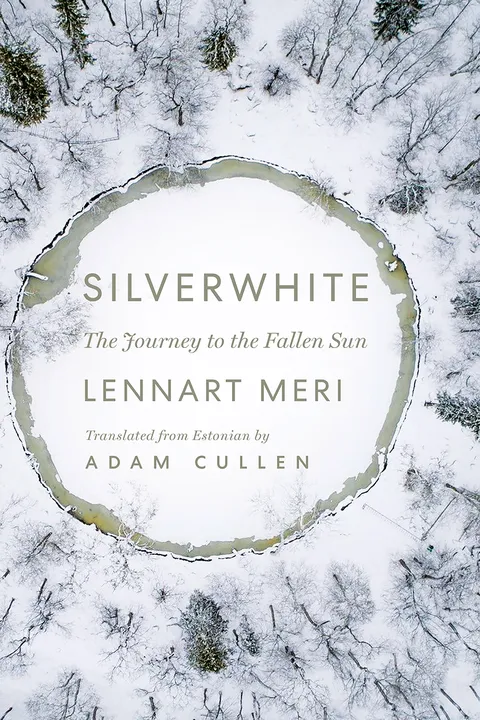
Silverwhite is a captivating exploration of the eastern Baltic nations’ earliest history and interactions with peoples of the Mediterranean and the Near East. This journey meticulously outlines an answer to the true whereabouts of Thule, the unearthly northernmost land of ancient legend.
Although Silverwhite is grounded in classical literature and extensive historical, astronomical and geographical fact, Lennart Meri—foremost a writer and filmmaker—weaves his travelogue with poeticism. Whereas a professional historian must show caution when using fantasy to patch gaps between facts, a poet is untethered. This epic work can also be read as a thriller: millennia ago, an enormous cosmic rock crashed into the Estonian island of Saaremaa. Through this extraordinary historical event, Meri brings together a curious cast including ancient Greeks, Arabs and Estonians. All genuinely existed and met, even if their names have been lost to oblivion.
When Meri wrote Silverwhite, Estonia was occupied; forced into the restrictions of Soviet Russian colonialism. His work was a balm against that closed-minded and unnatural state, offering the unmistakable message that the world has never been divided into isolated islands of civilisation. Nations, eternally interconnected, have always shared knowledge and impacted one another in complex ways. Openness is inherent.
Lennart Meri
Lennart Meri (1929–2006) was a traveller, writer and documentary filmmaker, and Estonian president from 1992 to 2001. His father being a diplomat, he was schooled in Paris and Berlin. When the Soviet Union occupied Estonia in 1940, his family was first imprisoned, then deported to Siberia; they survived against all odds, and returned after the Second World War. Meri strove relentlessly to articulate and defend Soviet-occupied Estonia’s interests, and worked to restore the nation’s sovereignty. His ten books and six ethnological films had an impact echoing across the Iron Curtain. On publication in 1976, Silverwhite quickly became a popular and central work of Estonian literature.
Adam Cullen
Translated by
Adam Cullen is a freelance translator of Estonian prose, poetry, and drama. His translations include novels by Mihkel Mutt (The Cavemen Chronicle, nominated for the 2015 Cultural Endowment of Estonia's Prize for Literary Translation), Rein Raud (The Brother and The Reconstruction, nominated for the 2017 Cultural Endowment of Estonia's Prize for Literary Translation), Kai Aareleid (Burning Cities), and Tonu Onnepalu (Radio). Cullen's debut collection of original poetry, Lichen / Samblik, was published in 2017. Originally from Minnesota, he has resided in Estonia since 2007.


Why Readwise Books?
Readwise Books is an ebook & audiobook platform that automatically logs how much you and your friends read, making it fun and easy to read more. Learn more →