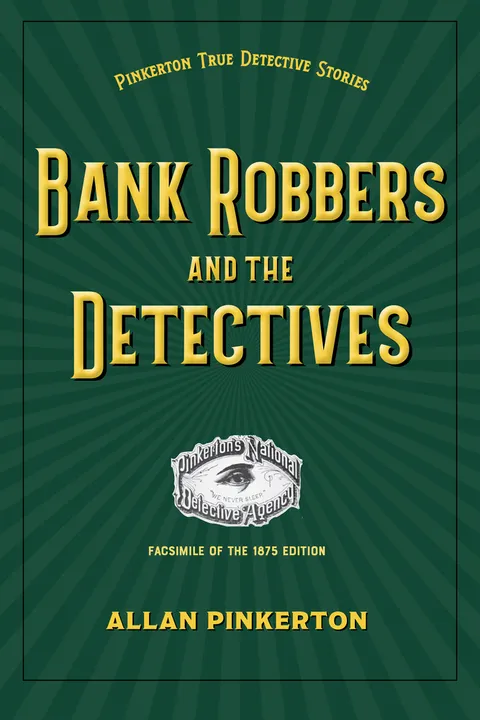
Bank Robbers and the Detectives
Report an issue
Tell us what's wrong and we'll take a look.
Thanks – we got it. We'll review and follow up if needed.
The Kent State University Press is excited to reissue these classic true crime detective stories by Allan Pinkerton, the Scottish American detective and spy who founded the Pinkerton National Detective Agency in 1850. His agency was the largest private law enforcement organization in the world at the height of its power, and its well-known logo of a large, unblinking eye actually served as inspiration for the term "private eye."
In Bank Robbers and the Detectives, Pinkerton receives a telegram that reads, "First National Bank robbed, please come, or send at once" from Thomas Locke in Somerset, Michigan. He sets off to investigate the crime. After journeying to the quaint town in a blizzard, the detective learns that $65,000 of treasury bonds, notes, and cash had disappeared from the bank's vault overnight. Only one man knew the combination: the bank's cashier, Mr. Norton. When Pinkerton's subsequent examination of the crime scene reveals no signs of forced entry, it starts to look like Mr. Norton committed the crime.
But if Pinkerton has learned anything during his three decades of detective work, it is that initial appearances are often deceiving, and he narrows the investigation down to three suspects close to the cashier. However, he soon discovers that the promise of exorbitant wealth can tempt even the most honorable man to commit treacherous crimes.
John Pinkerton
John Pinkerton (17 February 1758 - 10 March 1826) was a Scottish antiquarian, cartographer, essayist, numismatist, historian depending on the topic and a founder of the thesis of Germanic racial supremacy. He was one of three sons born to James Pinkerton and Mary (née Heron or Bowie) Pinkerton in Edinburgh. He spent some of his early childhood years in the city's neighborhood before moving to Lanark. His studious youth provided him with broad knowledge of the Classics, and it is known that he enjoyed translating Roman authors such as Livy as a child. After graduating from Edinburgh University, he stayed in the city to begin an apprenticeship in law. His scholastic interests, however, caused him to forsake the legal profession after he began authoring Elegy on Craigmillar Castle, which was first published in 1776.
More by John Pinkerton











Why Readwise Books?
Readwise Books is an ebook & audiobook platform that automatically logs how much you and your friends read, making it fun and easy to read more. Learn more →