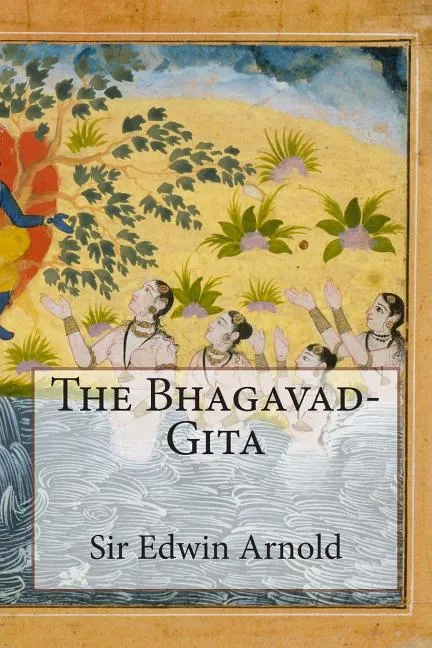
The Bhagavad-Gita
Report an issue
Tell us what's wrong and we'll take a look.
Thanks – we got it. We'll review and follow up if needed.
The Bhagavad Gita which is often referred to as simply the Gita, is a 700-verse Hindu scripture that is part of a Hindu epic. It is a sacred text of the Hindu religion. The Gita is set in a narrative framework of a dialogue between Pandava prince Arjuna and his guide and charioteer Lord Krishna. Facing the duty as a warrior to fight the Dharma Yudhha or righteous war between Pandavas and Kauravas, Arjuna is counselled by Lord Krishna to "fulfill his Kshatriya (warrior) duty as a warrior and establish Dharma." Inserted in this appeal to kshatriya dharma (chivalry) is "a dialogue ... between diverging attitudes concerning methods toward the attainment of liberation (moksha)". The Bhagavad Gita was exposed to the world through Sanjaya, who senses and cognises all the events of the battlefield. Sanjaya is Dhritarashtra's advisor and also his charioteer. The Gita is set in a narrative framework of a dialogue between Pandava prince Arjuna and his guide and charioteer Lord Krishna. Facing the duty as a warrior to fight the Dharma Yudhha or righteous war between Pandavas and Kauravas, Arjuna is counselled by Lord Krishna to "fulfill his Kshatriya (warrior) duty as a warrior and establish Dharma." Inserted in this appeal to kshatriya dharma (chivalry) is "a dialogue ... between diverging attitudes concerning methods toward the attainment of liberation (moksha)". The Bhagavad Gita presents a synthesis of the concept of Dharma, theistic bhakti, the yogic ideals of moksha through jnana, bhakti, karma, and Raja Yoga (spoken of in the 6th chapter) and Samkhya philosophy. It is a Bhagavata explanation of the Purusha Sukta and the Purushamedha Srauta yajna described in the Satapatha Brahmana. Numerous commentaries have been written on the Bhagavad Gita with widely differing views on the essentials. Vedanta commentators read varying relations between Self and Brahman in the text: Advaita Vedanta sees the non-dualism of Atman (soul) and Brahman as its essence, [12] whereas Bhedabheda and Vishishtadvaita see Atman and Brahman as both different and non-different, and Dvaita sees them as different. The setting of the Gita in a battlefield has been interpreted as an allegory for the ethical and moral struggles of the human life. The Bhagavad Gita's call for selfless action inspired many leaders of the Indian independence movement including Bal Gangadhar Tilak and Mahatma Gandhi. Gandhi referred to the Gita as his "spiritual dictionary". Theories on the date of composition of the Gita vary considerably. Scholars accept dates from the fifth century to the second century BCE as the probable range. Professor Jeaneane Fowler, in her commentary on the Gita, considers second century BCE to be the likely date of composition.[15] Kashi Nath Upadhyaya, a Gita scholar, on the basis of the estimated dates of Mahabharata, Brahma sutras, and other independent sources, concludes that the Bhagavad Gita was composed in the fifth or fourth century BCE. It is generally agreed that, "Unlike the Vedas, which have to be preserved letter-perfect, the Gita was a popular work whose reciters would inevitably conform to changes in language and style", so the earliest "surviving" components of this dynamic text are believed to be no older than the earliest "external" references we have to the Mahabharata epic, which may include an allusion in Panini's fourth century BCE grammar. It is estimated that the text probably reached something of a "final form" by the early Gupta period (about the 4th century CE). The actual dates of composition of the Gita remain unresolved.
Edwin Arnold
Sir. Edwin Arnold (10 June 1832 - 24 March 1904), was born in the United Kingdom. He was a journalist and poet, most popular as the writer of The Light of Asia (1879), which describes the life and lessons of Buddha. Pearls of the Faith (1883), on Islam, and The Light of the World (1891), on Christianity, got less success. After leaving the University of Oxford, Arnold became a schoolteacher in Birmingham, and later became principal of the British government college in Pune, India. He came back to Britain in 1861 to join the staff of the Daily Telegraph, where he worked as a chief editor from 1873 to 1889. He published various volumes of short poems, as well as translations of the Indian section and a good deal of travel composition. The essays collected in Japonica (1892) were a popular contribution to the late nineteenth-century (cult of Japan) in Britain, similar to his variations of Japanese poetry in The Tenth Muse (1895) and his Japanese play Adzuma (1893). He was knighted in 1888.
More by Edwin Arnold


Why Readwise Books?
Readwise Books is an ebook & audiobook platform that automatically logs how much you and your friends read, making it fun and easy to read more. Learn more →