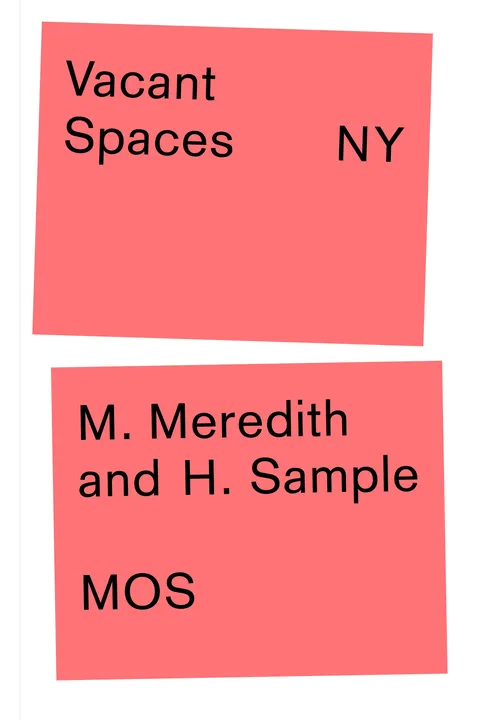
Vacant Spaces NY
Report an issue
Tell us what's wrong and we'll take a look.
Thanks – we got it. We'll review and follow up if needed.
Vacant Spaces NY begins gathering the incomplete data available and documenting vacant spaces in New York City. Organized from large to small, general to specific, vacancy in the United States to case studies of specific vacancies in Manhattan, Michael Meredith, Hilary Sample, and their architecture studio MOS imagine possibilities for repurposing current vacant spaces in New York City.
This project began by walking around our neighborhood noticing empty storefronts. Once we saw them, they were everywhere. They followed us, appearing quietly throughout New York City. Many with no signage, no “for rent,” no “coming soon.” Usually empty, sometimes dusty, sometimes with brown paper covering the glass. Now, vacancy has only increased. In the densest city in the United States. During a housing crisis. Throughout a pandemic. The quantity of vacant spaces is anyone’s best guess. It’s only partially documented. They hide in plain sight.
Vacant Spaces NY is organized from large to small, general to specific. It begins by looking at vacancy within the United States and continues down to each Manhattan neighborhood, where we zoom into specific vacant spaces, where we have provided as case studies that imagine some possibilities for transforming current vacant spaces into housing or social services. There is also a section on Covid 19, which infiltrated New York during our research. As a whole, this document is not meant to provide specific solutions. The data is incomplete. Case studies are limited. We are not policy experts or data analysts or urban planners. Instead, it is simply meant to show something we have taken for granted, vacant spaces, taking part in a collective process of imagining a better city.
Michael Meredith
Professor Mike Meredith is an oceanographer and Science Leader at the British Antarctic Survey (BAS) in Cambridge, UK.
He is head of the Polar Oceans team at BAS, which has research foci on determining the role of the polar oceans on global
climate, the ice sheets, and the interdisciplinary ocean system. He is an Honorary Professor at the University of Bristol, a
Fellow of the Royal Geographical Society, and a NERC Individual Merit Promotion (Band 2) scientist. He has published
more than 200 papers in international journals, and was the inaugural Chair of the Southern Ocean Observing System. He
led the design and delivery of the multi-institute ORCHESTRA programme, which is unravelling the role of the Southern
Ocean in controlling global climate. He was recently coordinating lead author for the IPCC Special Report on Oceans and
Cryosphere in a Changing Climate. In 2018, Mike was awarded the Tinker-Muse Prize for Science and Policy in Antarctica,
in recognition of his contributions to the study of the Southern Ocean and its global impacts, and the Challenger Medal, for
his contributions to marine science.
More by Michael Meredith




Why Readwise Books?
Readwise Books is an ebook & audiobook platform that automatically logs how much you and your friends read, making it fun and easy to read more. Learn more →