Report an issue
Tell us what's wrong and we'll take a look.
Thanks – we got it. We'll review and follow up if needed.
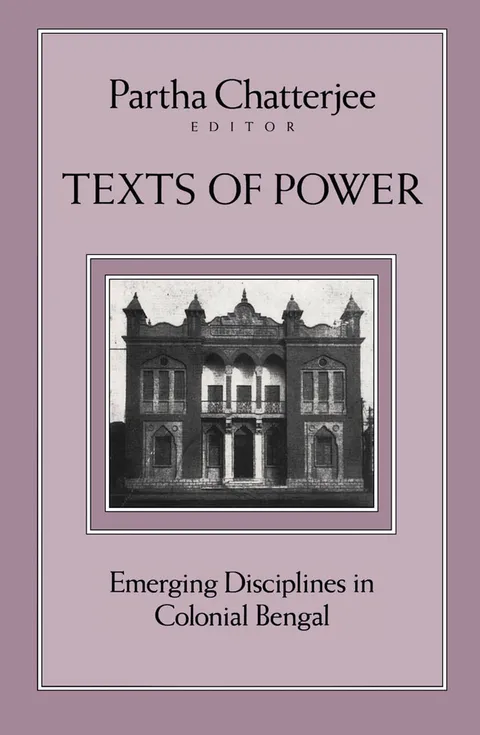
The case of Bengal illustrates the interaction of colonialism and modernity.
Bengal was the first "modern" province in India-the first, that is, to undergo a forced encounter with Western modernity. Beginning with this premise, the writers in Texts of Power consider what the case of Bengal says about the workings of Western modernity in a colonial setting.
A truly interdisciplinary effort, this collection probes questions of pedagogy, nationalism, and gender. Among the subjects explored are colonialist and nationalist surveillance of Bengali literature; the disposition of the nation's art; the politics of child-rearing; the mapping of Calcutta; and the disciplining of historical memory. By applying the theoretical insights of recent historical and cultural studies to the specific circumstances of Bengal, the authors develop a new approach to Indian intellectual and cultural history. Their work makes a significant contribution to our understanding of contemporary intellectual modernity.Contributors: Pradip Kumar Bose, Keya Dasgupta, Tapati Guha-Thakurta, all at the Centre for Studies in Social Sciences, Calcutta; Tapti Roy, Maharani Kashiswari College, Calcutta; Ranabir Samaddar, Maulana Azad Institute of Asian Studies.Partha Chatterjee
Partha Chatterjee (PhD, International Relations, Rlochester) is Professor of Anthropology, MESAAS, Columbia University and of the Centre for Studies in Social Sciences, Calcutta. He is the author of numerous books, including The Politics of the Governed (Columbia, 2004) and The Black Hole of Empire: History of a Global Practice of Power (Princeton, 2012). He is a founding member of the Subaltern Studies Collective and was awarded the Fukuoka Asian Culture Prize in 2009.
More by Partha Chatterjee







Why Readwise Books?
Readwise Books is an ebook & audiobook platform that automatically logs how much you and your friends read, making it fun and easy to read more. Learn more →