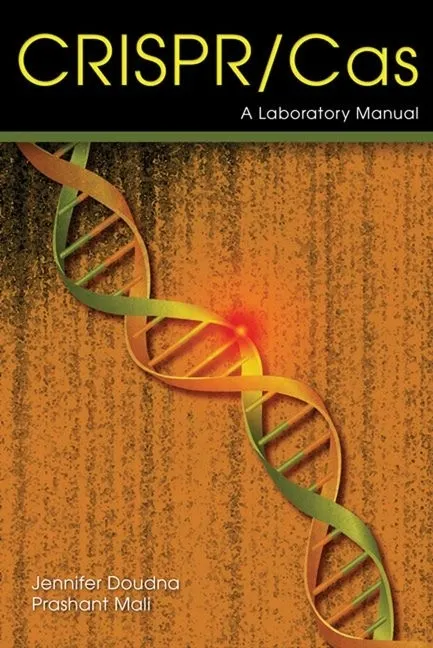
Crispr-Cas: A Laboratory Manual
Report an issue
Tell us what's wrong and we'll take a look.
Thanks – we got it. We'll review and follow up if needed.
Featuring contributions from leading figures in the CRISPR-Cas field, this laboratory manual presents a state-of-the-art guide to the technology. It includes step-by-step protocols for applying CRISPR-Cas-based techniques in various systems, including yeast, zebrafish, Drosophila, mice, and cultured cells (e.g., human pluripotent stem cells). The contributors cover web-based tools and approaches for designing guide RNAs that precisely target genes of interest, methods for preparing and delivering CRISPR-Cas reagents into cells, and ways to screen for cells that harbor the desired genetic changes. Strategies for optimizing CRISPR-Cas in each system--especially for minimizing off-target effects--are also provided.
Authors also describe other applications of the CRISPR-Cas system, including its use for regulating genome activation and repression, and discuss the development of next-generation CRISPR-Cas tools. The book is thus an essential laboratory resource for all cell, molecular, and developmental biologists, as well as biochemists, geneticists, and all who seek to expand their biotechnology toolkits.
Jennifer Doudna
JENNIFER A. DOUDNA, Ph.D. is a professor in the Chemistry and the Molecular and Cell Biology Departments at the University of California, Berkeley, investigator with the Howard Hughes Medical Institute, and researcher in the Molecular Biophysics and Integrated Bioimaging Division at the Lawrence Berkeley National Laboratory. She is internationally recognized as a leading expert on RNA-protein biochemistry, CRISPR biology, and genome engineering. Along with Emmanuelle Charpentier, she was awarded the 2020 Nobel Prize in Chemistry for their research on CRISPR-Cas9. She lives in the Bay Area.


Why Readwise Books?
Readwise Books is an ebook & audiobook platform that automatically logs how much you and your friends read, making it fun and easy to read more. Learn more →