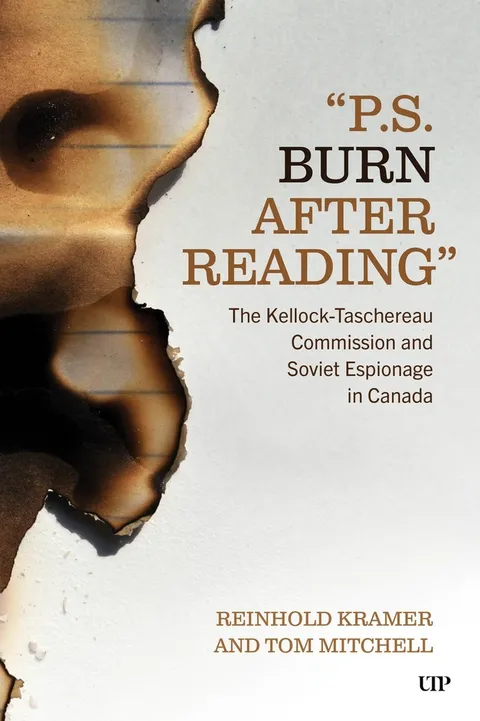
'Ps: Burn After Reading'
The Kellock-Taschereau Commision and Soviet Espionage
Report an issue
Tell us what's wrong and we'll take a look.
Thanks – we got it. We'll review and follow up if needed.
After Soviet cipher clerk Igor Gouzenko defected in 1945, Canada was shocked by the revelation that its own citizens were engaged in espionage for the Soviet Union. P.S. Burn After Reading explores how the Canadian government used the controversial Kellock-Taschereau Commission - sometimes judiciously, sometimes not - to uncover and thwart domestic spies during the early days of the Cold War.
Drawing on a wealth of sources, including the Commission's extensive records, GRU documents turned over by Gouzenko, American Venona decrypts, Soviet KGB archives, and newly released British MI5 and MI6 files, authors Reinhold Kramer and Tom Mitchell provide a comprehensive account of the crisis. They reveal that, despite some civil liberties missteps, the government's suspicions were largely justified.
The book weaves together the evidence against the spies, the tradecraft of Soviet espionage, complex legal challenges faced by the state, and the political fallout. With access to hundreds of newly released British intelligence files, P.S. Burn After Reading offers both specialists and general readers fresh insights into the espionage crisis of 1945-46 and the pivotal role it played in exposing Canada's postwar security and intelligence vulnerabilities.

Tom Mitchell
Tom Mitchell is mostly a dad, partly a teacher and sometimes a writer. He grew up in the West Country and settled in London after a brief interlude in the East Midlands. He lives in Kent with his wife, Nicky, and sons, Dylan and Jacob. He has written six middle-grade novels for HarperCollins Children's Books, with the latest being FIRST KID IN SPACE
More by Tom Mitchell







Why Readwise Books?
Readwise Books is an ebook & audiobook platform that automatically logs how much you and your friends read, making it fun and easy to read more. Learn more →