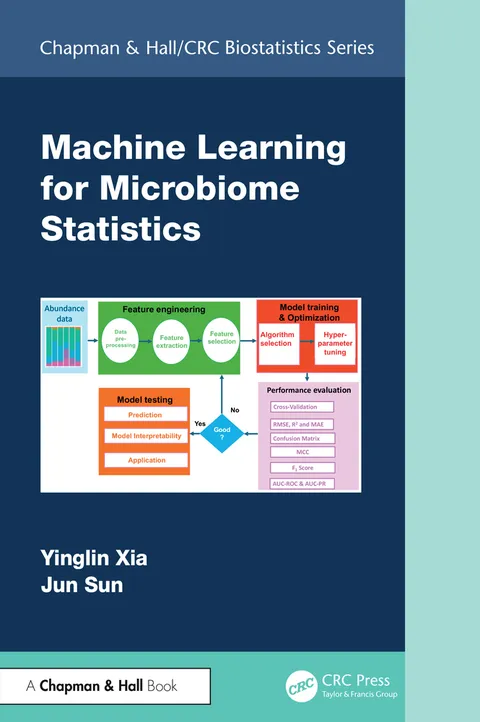
Machine Learning for Microbiome Statistics
Report an issue
Tell us what's wrong and we'll take a look.
Thanks – we got it. We'll review and follow up if needed.
Machine learning fundamentally learns from the past experiences (seen data) to make predictions about future (unseen data). Predictions in nature are often uncertain. Microbiome data have unique characteristics, including high-dimensionality, over-dispersion, sparsity and zero-inflation, and heterogeneity. Thus, machine learning involving microbiome data for predicting the outcome of phenotypes is even more uncertain than learning those data from other fields. Machine Learning for Microbiome Statistics poses many challenges for evaluating the prediction performance using appropriate metrics and independent data validation.
This unique book aims to address the challenges of machine learning statistics, emphasize the importance of performance valuation by appropriate metrics and independent data, and describe several important concepts of machine learning statistics, such as feature engineering and overfitting. It comprehensively reviews commonly used and newly developed machine learning models for microbiome research. Specifically, this book provides the step-by-step procedures to perform machine learning of microbiome data, including feature engineering, algorithm selection and optimization, performance evaluation and model testing. It comments the benefits and limitations of using machine learning for microbiome statistics and remarks on the advantages and disadvantages of each machine learning algorithm.
It will be an excellent reference book for students and academics in the field.
- Presents a thorough overview of machine learning algorithms for microbiome statistics.
- Performs step-by-step procedures to perform machine learning of microbiome data, using important supervised learning algorithms, including classical, ensemble learning and tree-based models.
- Describes important concepts of machine learning, including bias and variance tradeoff, accuracy and precision, overfitting and underfitting, model complexity and interpretability, and feature engineering.
- Investigates and applies various cross-validation techniques step-by-step.
- Introduces confusion matrix and its derived measures. Comprehensively describes the properties of F1, Matthews' correlation coefficient (MCC), area under the receiver operating characteristic curve (AUC-ROC), and area under the precision-recall curve (AUC-PR), as well as discusses their advantages and disadvantages when using them for microbiome data.
- Offers all related R codes and the datasets from the authors' first-hand microbiome research and publicly available data.
Jun Sun
Dr. Jun Sun is a tenured Professor of Medicine at the University of Illinois at Chicago (UIC), U.S.A.. She is an elected fellow of American Gastroenterological Associate (AGA) and American Physiology Society (APS). She is the Chair-elected for the AGA microbiome section. Her research interests are host-microbiome interactions in inflammation and cancer. Her key achievements include 1) characterization of vitamin D receptor regulation of gut microbiome in intestinal homeostasis and inflammation, 2) identification of dysbiosis and intestinal dysfunction in Amyotrophic lateral sclerosis (ALS), 3) characterization of bacteria in regulating intestinal stem cells and leading to cancer, and 4) identification and characterization of the Salmonella protein AvrA in host-bacterial interactions. Dr. Sun has published over 170 scientific articles in peer-reviewed journals, including Gut, Gastroenterolog, Cell Stem Cells, Nature Genetics, JBC, Autophagy, American Journal of Pathology, & American Journal of Physiology-GI. She is the leading editor of three books, including a recent Nature/Spring book entitled "Mechanisms underlying host-microbiome interactions in pathophysiology of human diseases." This book has shown a novel theme and multiple disciplinary topics of microbiome research for broad audience. She is the author of Nature/Spring book "Statistical Analysis of Microbiome Data with R. This timely book addresses the statistical modelling and analysis of microbiome data using cutting-edge R software. She serves the editorial board of more than 10 peer-reviewed international scientific journals. She services study sections for the NIH, American Cancer Society, and other national and international research foundations. She has been invited to chair meetings on microbiome, be a keynote speaker, and to write reviews, editorials, and comments on microbiome in human diseases for peer-reviewed journals. She is actively involved in advocating microbiome research at the international, national and institutional levels. Her research is supported by the NIH, DOD, and other research awards.
Dr. Sun is a believer of scientific art and artistic science. She enjoys writing her science papers in English and poems in Chinese. She teaches her medical fellows biomedical knowledge and also the way to translate the Chinese poems. In addition to her research papers and books, her poetry collection《让时间停留在这一刻 》"Let time stay still at this moment" is published in 2018 by the Chinese Literature and History Press.
More by Jun Sun


Why Readwise Books?
Readwise Books is an ebook & audiobook platform that automatically logs how much you and your friends read, making it fun and easy to read more. Learn more →