Report an issue
Tell us what's wrong and we'll take a look.
Thanks – we got it. We'll review and follow up if needed.
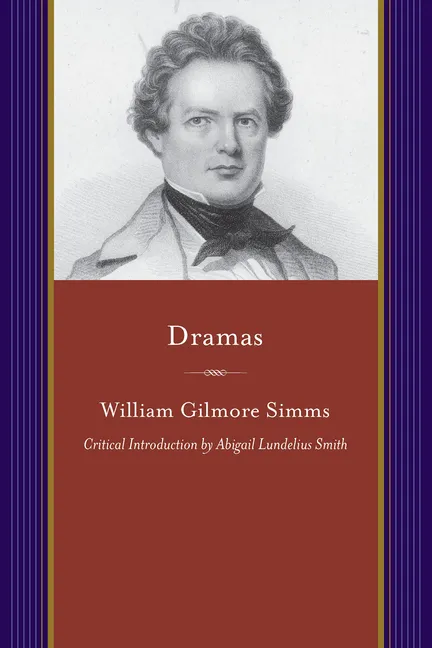
William Gilmore Simms's Norman Maurice was a lofty experiment, mixing contemporary politics with common language presented in the format of the Elizabethan tragedy. Written in strict blank verse, Norman Maurice is a play in which the Constitutional and slavery questions that continued to persist after the Missouri Compromise and Nullification Crisis are discussed in detail. Yet, the blank verse Simms used was not poetic, Shakespearean language; rather, Simms presented mid-nineteenth century American vernacular in blank verse. In presenting the political, philosophical, and moral questions of the day as essentially tragic, Simms created a powerful and moving play.
One of the other dramas in this collection, Michael Bonham, is based on James Butler Bonham, a South Carolina native and lieutenant in the Texas Calvary, who died in the battle of the Alamo on March 6, 1836. The final titular drama, Benedict Arnold, is one of Simms's more obscure works. Through this text, Simms experimented with literary aesthetics -- combining drama and essay, which are two genres generally considered to be disparate. Its sophisticated intellectual exploration of the ramifications of history make it worthy of serious critical attention.
William Gilmore Simms
William Gilmore Simms was a poet, novelist, politician, and historian from the American South. His writings rose to prominence during the nineteenth century, with Edgar Allan Poe proclaiming him the best author America had ever produced. He is still regarded by literary academics as a prominent figure in antebellum Southern literature. He is also renowned for his ardent support for slavery and his hostility to Uncle Tom's Cabin, which prompted him to write critiques and the pro-slavery novel The Sword and the Distaff (1854). During his literary career, he worked as an editor for various journals and newspapers, and he also served in the South Carolina House of Representatives. Simms was born on April 17, 1806, in Charleston, South Carolina, of Scots-Irish forebears. His mother, Harriet Ann Augusta (née Singleton, 1784-1808), died in his infancy, and his father, William Gilmore Simms Senior (1762-1830), failed in business and joined Coffee's Indian fighters. Simms was reared by his maternal grandmother, Jane Miller Singleton Gates, who lived during the American Revolutionary War and told him stories about it. Simms worked as a drugstore clerk during his adolescence and intended to become a doctor. Simms began studying law when he was eighteen (about 1824). In 1841, the University of Alabama awarded him an honorary LLD.
More by William Gilmore Simms


Why Readwise Books?
Readwise Books is an ebook & audiobook platform that automatically logs how much you and your friends read, making it fun and easy to read more. Learn more →