Report an issue
Tell us what's wrong and we'll take a look.
Thanks – we got it. We'll review and follow up if needed.
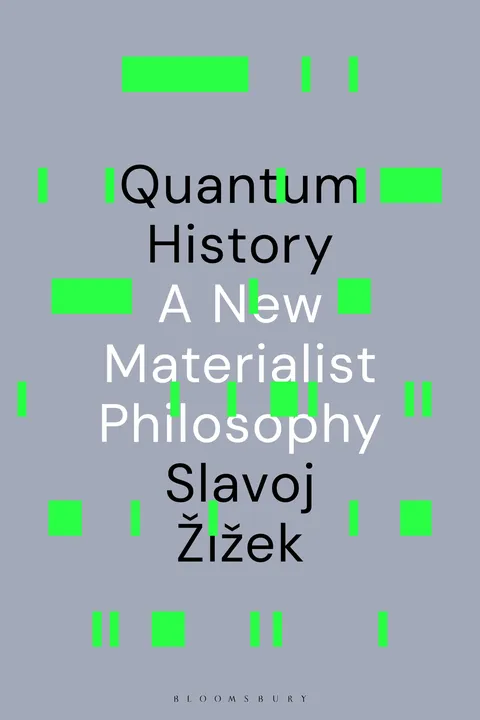
A panoramic view of the cosmos must begin with the tension of a single political moment. In Quantum History, Slavoj Žižek brings together Hegelian dialectics, Lacan psychoanalysis and quantum mechanics to rethink history, reality and political possibility.
Taking up Lenin's challenge to radically reconsider materialism in the wake of each big scientific discovery, and rejecting the recent vogue for giving a vague spiritualist spin to wave mechanics, Žižek embraces the philosophical implications of quantum mechanics with characteristic erudition and verve. Drawing on the central themes of the holographic universe, non-commutativity and the collapse of superpositions, Žižek evolves a quantum-inspired ontology which reinvents the historical materialism of Hegel and Heidegger – and compels a brutal, often darkly funny, inquisition into the chances of radical emancipatory acts today.
Quantum History takes the reader from the absolute contradiction of the primordial void through quantum oscillations to our ordinary reality, weaving in Lacan and Deleuze, Rovelli and Schelling, opera, cinema, sex and war. Žižek is at his sharpest, saddest, most provocative best as he demonstrates that there is no way of extracting ourselves from the texture of history, no neutral position from which the workings of the world can be observed transparently – we must act from a contingent, complex and inscrutable political moment, in sadness and in doubt, but defiantly.
Slavoj Žižek
Slavoj Žižek is Professor of Philosophy at the European Graduate School, senior researcher at the Institute for Sociology and Philosophy at the University of Ljubljana, Global Distinguished Professor of German at New York University, International Director of the Birkbeck Institute for the Humanities, and founder and president of the Society for Theoretical Psychoanalysis, Ljubljana. Since The Sublime Object of Ideology in 1989, his first book in English, Žižek has published over forty books, spanning from political theory to cultural studies and bringing together the influences of Hegelian idealism, Lacanian psychoanalysis, and Marxist thought. Among his most recent publications are The Relevance of the Communist Manifesto (2018), Like a Thief in Broad Daylight: Power in the Era of Posthumanity (2018), and Sex and the Failed Absolute (2019).
More by Slavoj Žižek






Why Readwise Books?
Readwise Books is an ebook & audiobook platform that automatically logs how much you and your friends read, making it fun and easy to read more. Learn more →