Report an issue
Tell us what's wrong and we'll take a look.
Thanks – we got it. We'll review and follow up if needed.
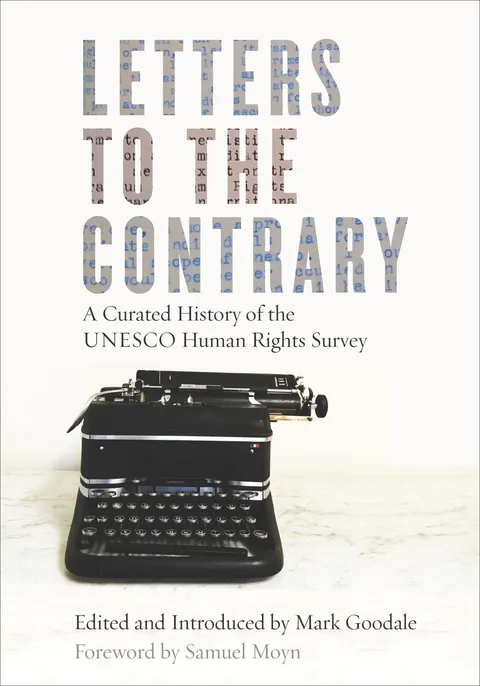
This remarkable collection of letters reveals the debate over universal human rights. Prominent mid-twentieth-century intellectuals and leaders--including Gandhi, T.S. Eliot, W.H. Auden, Aldous Huxley, Jawaharlal Nehru, and Arnold Schoenberg--engaged with the question of universal human rights. Letters to the Contrary presents the foundation of the intellectual struggles and ideological doubts still present in today's human rights debates.
Since its adoption in 1948, historians and human rights scholars have claimed that the Universal Declaration of Human Rights was influenced by UNESCO's 1947-48 global survey of intellectuals, theologians, and cultural and political leaders, that supposedly demonstrated a truly universal consensus on human rights. Based on meticulous archival research, Letters to the Contrary provides a curated history of the UNESCO human rights survey and demonstrates its relevance to contemporary debates over the origins, legitimacy, and universality of human rights. In collecting, annotating, and analyzing these responses, including letters and responses that were omitted and polite refusals to respond, Mark Goodale shows that the UNESCO human rights survey was much less than supposed, but also much more. In many ways, the intellectual struggles, moral questions, and ideological doubts among the different participants who both organized and responded to the survey reveal a strikingly critical and contemporary orientation, raising similar questions at the center of current debates surrounding human rights scholarship and practice.
This volume contains letters and survey responses from Jacques Havet, Jacques Maritain, Arnold J. Lien, Richard P. Mckeon, Quincy Wright, Levi Carneiro, Arthur H. Compton, Charles E. Merriam, Lewis Mumford, E. H. Carr, John Lewis, Harold J. Laski, Serge Hessen, John Somerville, Boris Tchechko, Luc Somerhausen, Hyman Levy, Ture Nerman, R. Palme Dutt, Maurice Dobb, Pierre Teilhard De Chardin, Marcel De Corte, Pedro Troncoso Sánchez, Mahatma Gandhi, Chung-Shu Lo, Kurt Riezler, Inocenc Arnost Bláha, Hubert Frère, M. Nicolay, W. Albert Noyes, Jr., Aldous Huxley, Ralph W. Gerard, Johannes M. Burgers, Humayun Kabir, A. P. Elkin, S. V. Puntambekar, Leonard Barnes, Benedetto Croce, Jean Haesart, F. S. C. Northrop, Peter Skov, Emmanuel Mounier, Maurice Webb, John Macmurray, Julius Moór, L. Horváth, Alfred Weber, Don Salvador De Madariaga, Frank R. Scott, Jawaharlal Nehru, Margery Fry, Isaac Leon Kandel, René Maheu, Albert Szent-Györgyi, Morris L. Ernst, Arnold Schoenberg, W. H. Auden, Melville Herskovits, Theodore Johannes Haarhoff, Ernest Henry Burgmann, Herbert Read, and T. S. Eliot.
Mark Goodale
Mark Goodale is Professor of Cultural and Social Anthropology at the University of Lausanne. Previously, he was Professor of Conflict Studies and Anthropology at George Mason University and the first Marjorie Shostak Distinguished Lecturer in Anthropology at Emory University. He is the author of Surrendering to Utopia: An Anthropology of Human Rights (Stanford UP, 2009) and Dilemmas of Modernity: Bolivian Encounters with Law and Liberalism (Stanford UP, 2008) and the editor or coeditor of eleven other volumes on anthropology, human rights, legal pluralism, justice, Latin American politics and society, and methodology. The founding Series Editor of Stanford Studies in Human Rights, he is currently writing a book about revolution, ideology, and law in Bolivia based on several years of ethnographic research funded by the US National Science Foundation and the Wenner-Gren Foundation for Anthropological Research.
More by Mark Goodale


Why Readwise Books?
Readwise Books is an ebook & audiobook platform that automatically logs how much you and your friends read, making it fun and easy to read more. Learn more →