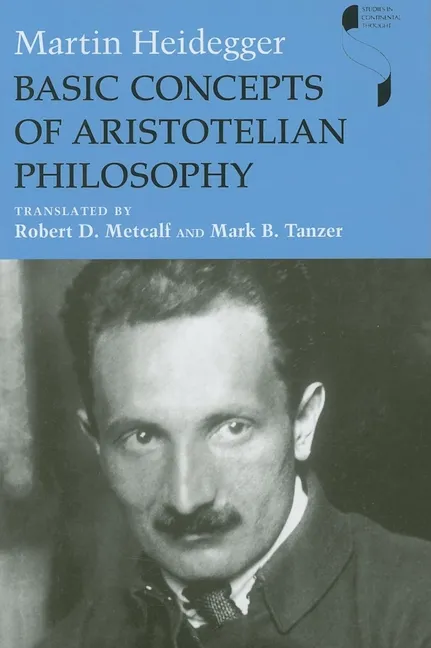
Basic Concepts of Aristotelian Philosophy
Report an issue
Tell us what's wrong and we'll take a look.
Thanks – we got it. We'll review and follow up if needed.
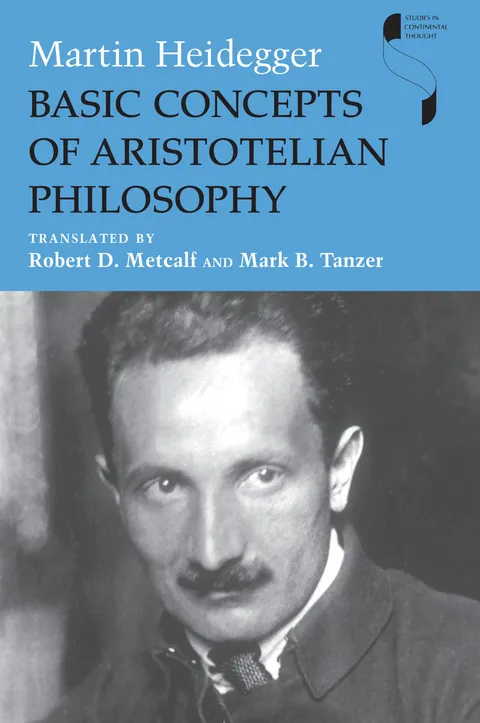
Volume 18 of Martin Heidegger's collected works presents his important 1924 Marburg lectures which anticipate much of the revolutionary thinking that he subsequently articulated in Being and Time. Here are the seeds of the ideas that would become Heidegger's unique phenomenology. Heidegger interprets Aristotle's Rhetoric and looks closely at the Greek notion of pathos. These lectures offer special insight into the development of his concepts of care and concern, being-at-hand, being-in-the-world, and attunement, which were later elaborated in Being and Time. Available in English for the first time, they make a significant contribution to ancient philosophy, Aristotle studies, Continental philosophy, and phenomenology.
Martin Heidegger
Heidegger’s contribution to the growth and development of National Socialism was immense. In this small anthology, Dr. Runes endeavors to point to the utter confusion Heidegger created by drawing, for political and social application of his own existentialism and metaphysics, upon the decadent and repulsive brutalization of Hitlerism. Martin Heidegger was a philosopher most known for his contributions to German phenomenological and existential thought. Heidegger was born in rural Messkirch in 1889 to Catholic parents. While studying philosophy and mathematics at Albert-Ludwig University in Freiburg, Heidegger became the assistant for the philosopher Edmund Husserl. Influenced by Husserl, Kierkegaard, and Nietzsche, Heidegger wrote extensively on the quality of Being, including his Opus Being and Time. He served as professor of philosophy at Albert-Ludwig University and taught there during the war. In 1933, Heidegger joined the National Socialist German Worker’s (or Nazi) Party and expressed his support for Hitler in several articles and speeches. After the war, his support for the Nazi party came under attack, and he was tried as a sympathizer. He was able to return to Albert Ludwig University, however, and taught there until he retired. Heidegger continued to lecture until his death in 1973.
More by Martin Heidegger







Why Readwise Books?
Readwise Books is an ebook & audiobook platform that automatically logs how much you and your friends read, making it fun and easy to read more. Learn more →