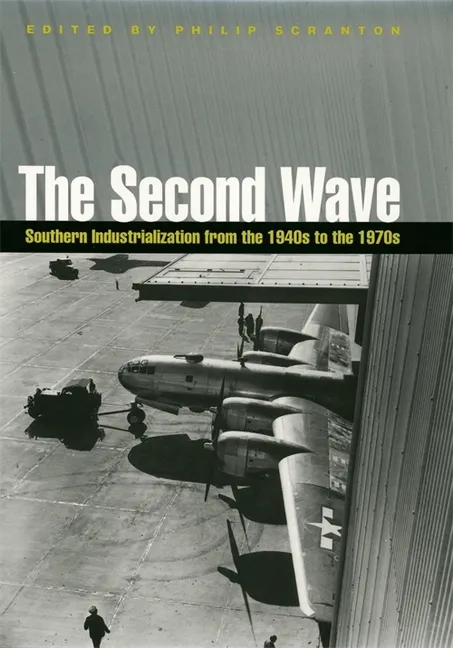
Second Wave
Report an issue
Tell us what's wrong and we'll take a look.
Thanks – we got it. We'll review and follow up if needed.

Though it had helped define the New South era, the first wave of regional industrialization had clearly lost momentum even before the Great Depression. These nine original case studies look at how World War II and its aftermath transformed the economy, culture, and politics of the South.
From perspectives grounded in geography, law, history, sociology, and economics, several contributors look at southern industrial sectors old and new: aircraft and defense, cotton textiles, timber and pulp, carpeting, oil refining and petrochemicals, and automobiles. One essay challenges the perception that southern industrial growth was spurred by a disproportionate share of federal investment during and after the war.
In covering the variety of technological, managerial, and spatial transitions brought about by the South's "second wave" of industrialization, the case studies also identify a set of themes crucial to understanding regional dynamics: investment and development; workforce training; planning, cost-containment, and environmental concerns; equal employment opportunities; rural-to-urban shifts and the decay of local economies entrepreneurism; and coordination of supply, service, and manufacturing processes. From boardroom to factory floor, the variety of perspectives in The Second Wave will significantly widen our understanding of the dramatic reshaping of the region in the decades after 1940.
Philip Scranton
Philip Scranton is an emeritus Board of Governors professor of history at Rutgers University. He is the author of Endless Novelty: Specialty Production and American Industrialization, 1865-1925, and a coauthor of Reimagining Business History.


Why Readwise Books?
Readwise Books is an ebook & audiobook platform that automatically logs how much you and your friends read, making it fun and easy to read more. Learn more →