Report an issue
Tell us what's wrong and we'll take a look.
Thanks – we got it. We'll review and follow up if needed.
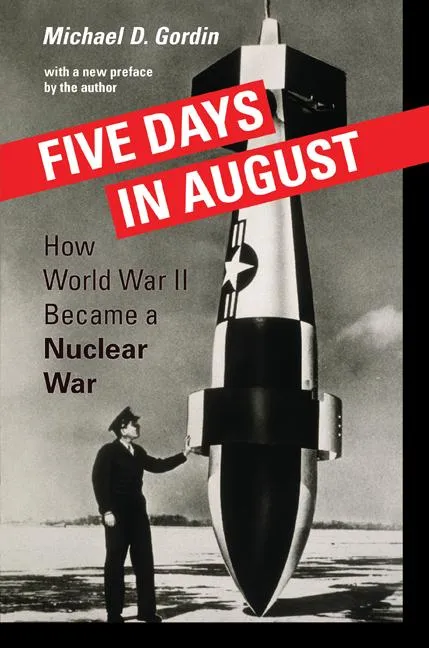
"A gripping reconsideration of how the atomic bomb figured in the ending of World War II." —Daniel J. Kevles, author of The Physicists With a New Preface by the Author Most Americans believe that the Second World War ended because the two atomic bombs dropped on Japan forced it to surrender. Five Days in August boldly presents a different interpretation: that the military did not clearly understand the atomic bomb's revolutionary strategic potential, that the Allies were almost as stunned by the surrender as the Japanese were by the attack, and that not only had experts planned and fully anticipated the need for a third bomb, they were skeptical about whether the atomic bomb would work at all. With these ideas, science historian Michael D. Gordin reorients the historical and contemporary conversation about the A-bomb and World War II. Five Days in August explores these and countless other legacies of the atomic bomb in a glaring new light. Daring and iconoclastic, it will result in far-reaching discussions about the significance of the A-bomb, about World War II, and about the moral issues they have spawned.
Michael D Gordin
Michael D. Gordin is Rosengarten Professor of Modern and Contemporary History and the director of the Society of Fellows in the Liberal Arts at Princeton University. He specializes in the history of modern science in Russia, Europe, and North America, in particular on issues related to the history of fringe science, the early years of the nuclear arms race, Russian and Soviet science, language and science, and Albert Einstein. He is the author of The Pseudoscience Wars: Immanuel Velikovsky and the Birth of the Modern Fringe, Scientific Babel: How Science Was Done Before and After Global English, and Red Cloud at Dawn: Truman, Stalin, and the End of the Atomic Monopoly.
More by Michael D Gordin






Why Readwise Books?
Readwise Books is an ebook & audiobook platform that automatically logs how much you and your friends read, making it fun and easy to read more. Learn more →