Report an issue
Tell us what's wrong and we'll take a look.
Thanks – we got it. We'll review and follow up if needed.
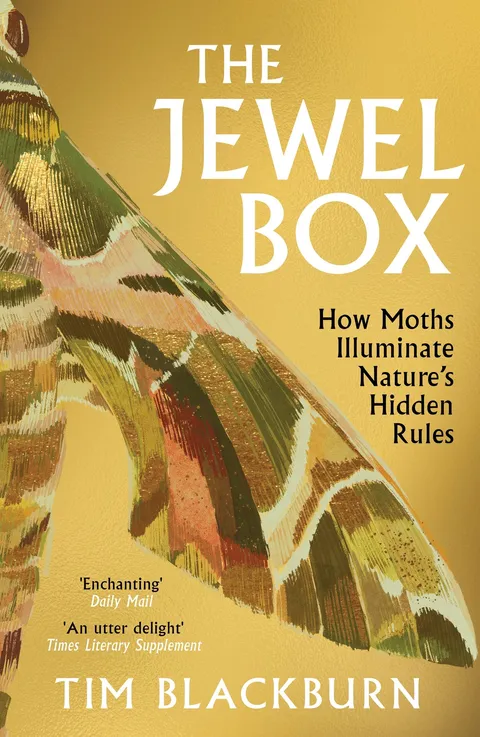
Every morning, ecologist Tim Blackburn is inspired by the diversity contained within the moth trap he runs on his roof. Beautiful and ineffably mysterious, these moths offer a glimpse into a larger order, one that extends beyond individual species and into a hidden landscape.
Footmen, whose populations are on the march as their lichen food recovers from decades of industrial pollution. The Goat Moth, a thumb-sized broken stick mimic, that takes several years to mature deep in the wood of tree trunks. The Oak Eggar, with the look of a bemused Honey Monster, host to a large wasp that eats its caterpillars alive from the inside. The Uncertain, whose similarity to other species has motivated its English name. The Silver Y, with a weight measured in milligrams, but capable of migrating across a continent. A moth trap is a magical contraption, conjuring these and hundreds of other insect jewels out of the darkness.
Just as iron filings arrange themselves to articulate a magnetic field that would otherwise be invisible, Blackburn shows us that when we pay proper attention to these tiny animals, their relationships with one another and their connections to the wider web of life, a greater truth about the world gradually emerges. In THE JEWEL BOX, he reflects on what he has learned in thirty years of work as a scientist studying ecosystems, and demonstrates how the contents of one small box can illuminate the workings of all nature.
Tim Blackburn
Tim Blackburn is professor of invasion biology at University College London. Previously, he was the director of the Institute of Zoology, the research arm of the Zoological Society of London, where he still has a research affiliation. He has been awarded Honorary Professorships at the Universities of Adelaide, Birmingham, and Oxford, been named an Honorary Research Associate at the Centre of Excellence in Invasion Biology, Stellenbosch, and been an invited plenary speaker at numerous international conferences. His work in the 1990s with Kevin Gaston helped to define the newly emerging field of macroecology-the study of large-scale patterns in the distribution and abundance of species-and he has since gone on to make substantial contributions to the science of biological invasions. His own writing has appeared in the Biologist and the Conversation, and his findings have been covered by (amongst others) PBS, the BBC's Inside Science and Countryfile, the Guardian, Telegraph, and Evening Standard, Metro, the National (UAE), India Times, Republic (India), Suddeutsche Zeitung (Germany), Publimetro (Mexico), Irish Times, and ABC (Australia).







Why Readwise Books?
Readwise Books is an ebook & audiobook platform that automatically logs how much you and your friends read, making it fun and easy to read more. Learn more →