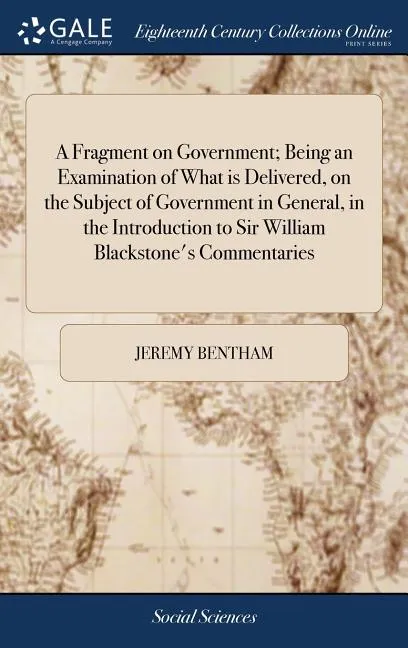
A Fragment on Government; Being an Examination of What is Delivered, on the Subject of Government in General, in the Introduction to Sir William Blackstone's Commentaries
With a Preface, in Which is Given a Critique on the Work at Large
Report an issue
Tell us what's wrong and we'll take a look.
Thanks – we got it. We'll review and follow up if needed.
The 18th century was a wealth of knowledge, exploration and rapidly growing technology and expanding record-keeping made possible by advances in the printing press. In its determination to preserve the century of revolution, Gale initiated a revolution of its own: digitization of epic proportions to preserve these invaluable works in the largest archive of its kind. Now for the first time these high-quality digital copies of original 18th century manuscripts are available in print, making them highly accessible to libraries, undergraduate students, and independent scholars.
Delve into what it was like to live during the eighteenth century by reading the first-hand accounts of everyday people, including city dwellers and farmers, businessmen and bankers, artisans and merchants, artists and their patrons, politicians and their constituents. Original texts make the American, French, and Industrial revolutions vividly contemporary.
++++
The below data was compiled from various identification fields in the bibliographic record of this title. This data is provided as an additional tool in helping to insure edition identification:
++++
Bodleian Library (Oxford)
N003305
Anonymous. By Jeremy Bentham.
Dublin: printed for J. Sheppard, W. Whitestone, J. Hoey, J. Potts, J. Williams, [and 8 others in Dublin], 1776. [2], xli, [1],132p.; 8°
Jeremy Bentham
Jeremy Bentham (1748-1832) was the founder of the doctrine of utilitarianism, outlined in "An Introduction to the Principles of Morals and Legislation" (1789). His work on the Panopticon began in 1785. His concern with legal reform and codification continued throughout his life, and he was a campaigner for universal suffrage, the secret ballot and the abolition of capital and corporal punishment.
More by Jeremy Bentham



Why Readwise Books?
Readwise Books is an ebook & audiobook platform that automatically logs how much you and your friends read, making it fun and easy to read more. Learn more →