Crumbling idols; twelve essays on art, dealing chiefly with literature, painting the drama
Crumbling Idols is a collection of 12 essays written and completed by Hamlin Garland in 1894.
Report an issue
Tell us what's wrong and we'll take a look.
Thanks – we got it. We'll review and follow up if needed.
Crumbling Idols is a collection of 12 essays written and completed by Hamlin Garland in 1894. Garland was one of the most prominent American authors of the early 20th century, and contributed heavily to the literary movement known as American Realism. His work, Crumbling Idols, expresses his views and manifesto as a veritist (realist) artist. In it, he repeatedly emphasizes the importance of a uniquely American literature, one that breaks away from tradition and the past and focuses on the present in order to depict reality through the artists own eyes. Crumbling Idols was decreed a controversial work by the general population and critics during the time of its publication as it attacked many of the features and ideas of nineteenth century literature. Three of his essays, "Provincialism", "Literary Centres", and "Literary Masters", were especially controversial and criticized as they heavily attacked the "imitated" literature of the east coast as well as the lack of innovation in American literature as a whole. Most of his other essays worked to promote realist ideals and values, such as local color and distinction and originality in art. Crumbling Idols was especially supported by fellow Realist authors, such as William Dean Howells and Stephen Crane....Garland defines provincialism as the "dependence upon a mother country for models of art production."[1] Garland criticizes American writers of the early-mid 19th century for imitating the artistic styles of other nations, and called for a new and purely American art, especially in literature. He especially goes after the mid-western states, schools, and the middle class for refusing to accept new and evolving art forms. Garland says of the mid-western states, of where he was born, "Its literary clubs valiantly discuss dead issues in English literature, and vote in majority against the indigenous."[2] It disappoints him that the mid-west continues to settle for old, romantic literature rather than producing and supporting new forms of a distinctly mid-western art. Garland places much of the blame on American schools he charges with indoctrinating pupils in worshipping the past while turning a blind eye to new and upcoming literary movements. If students are to study authors such as Whitman, Howells, and Ibsen, they must do it on their own. The most provincial of us all, Garland asserts, is the middle class, as they are the product of the schools that teach conservatism in literature. Garland was a strong opponent of American provincialism and worked hard to advocate a strong, national literature that would be completely independent from other nations. The style doesn't necessarily need to be better, just different. He assures us, however, that there is hope. The fact that we study the past through such writers as Shakespeare is better than not engaging in literature at all. It is, as Garland says a, "sign of life, and not of death."... Hannibal Hamlin Garland (September 14, 1860 - March 4, 1940) was a Pulitzer prizewinning American novelist, poet, essayist, and short story writer, Georgist, and parapsychology skeptic/researcher. He is best known for his fiction involving hard-working Midwestern farmers.Hannibal Hamlin Garland was born on a farm near West Salem, Wisconsin, on September 14, 1860, the second of four children of Richard Garland of Maine and Charlotte Isabelle McClintock.The boy was named after Hannibal Hamlin, the candidate for vice-president under Abraham Lincoln.He lived on various Midwestern farms throughout his young life, but settled in Boston, Massachusetts, in 1884 to pursue a career in writing. He read diligently in the Boston Public Library.There he became enamored with the ideas of Henry George, and his Single Tax Movement.George's ideas came to influence a number of his works, such as Main-Travelled Roads (1891), Prairie Folks (1892), and his novel Jason Edwards (1892).....
Hamlin Garland
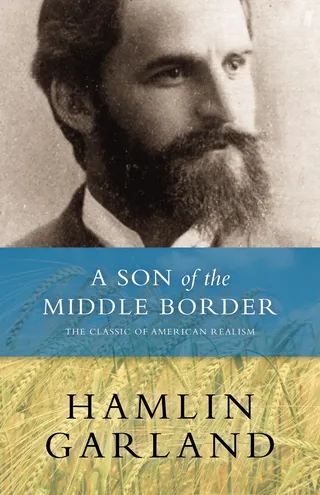
Hannibal Hamlin Garland was an American novelist, poet, essayist, short story author, Georgist, and psychical researcher. He is best known for his fiction about hardworking Midwestern farmers. Hannibal Hamlin Garland was born on a farm near West Salem, Wisconsin, on September 14, 1860, as the second of four children of Richard Garland of Maine and Charlotte Isabelle McClintock. The boy was named after Abraham Lincoln's vice president, Hannibal Hamlin. He grew up on numerous Midwestern farms before relocating to Boston, Massachusetts, in 1884 to pursue a writing career. He read diligently at the Boston Public Library. There he grew infatuated with Henry George's views and the Single Tax Movement. George's beliefs influenced several of his writings, including Main-Travelled Roads (1891), Prairie Folks (1892), and his novel Jason Edwards (1892). Main-Travelled Roads was his first big hit. It was a compilation of short stories inspired by his time on the farm. He serialized a biography of Ulysses S. Grant in McClure's Magazine before turning it into a book in 1898. The same year, Garland visited the Yukon to observe the Klondike Gold Rush, which inspired The Trail of the Gold Seekers (1899).
More by Hamlin Garland




Why Readwise Books?
Readwise Books is an ebook & audiobook platform that automatically logs how much you and your friends read, making it fun and easy to read more. Learn more →