Report an issue
Tell us what's wrong and we'll take a look.
Thanks – we got it. We'll review and follow up if needed.
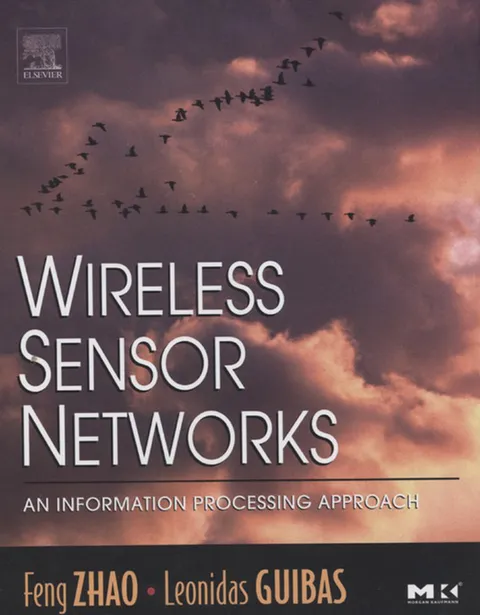
Information processing in sensor networks is a rapidly emerging area of computer science and electrical engineering research. Because of advances in micro-sensors, wireless networking and embedded processing, ad hoc networks of sensor are becoming increasingly available for commercial, military, and homeland security applications. Examples include monitoring (e.g., traffic, habitat, security), industrail sensing and diagnostics (e.g., factory, appliances), infrastructures (i.e., power grid, water distribution, waste disposal) and battle awareness (e.g., multi-target tracking). This book introduces practitioners to the fundamental issues and technology constraints concerning various aspects of sensor networks such as information organization, querying, routing, and self-organization using concrete examples and does so by using concrete examples from current research and implementation efforts.
- Written for practitioners, researchers, and students and relevant to all application areas, including environmental monitoring, industrial sensing and diagnostics, automotive and transportation, security and surveillance, military and battlefield uses, and large-scale infrastructural maintenance
- Skillfully integrates the many disciplines at work in wireless sensor network design: signal processing and estimation, communication theory and protocols, distributed algorithms and databases, probabilistic reasoning, energy-aware computing, design methodologies, evaluation metrics, and more
- Demonstrates how querying, data routing, and network self-organization can support high-level information-processing tasks
Leonidas Guibas
Professor Guibas heads the Geometric Computation group in the Computer Science Department of Stanford University, where he works on algorithms for sensing, modeling, reasoning about, rendering, and acting on the physical world. He is well-known for his work in computational geometry, computer graphics, and discrete algorithms. Professor Guibas obtained his Ph.D. from Stanford, has worked at PARC, MIT, and DEC/SRC, and was recently elected an ACM Fellow.
More by Leonidas Guibas



Why Readwise Books?
Readwise Books is an ebook & audiobook platform that automatically logs how much you and your friends read, making it fun and easy to read more. Learn more →