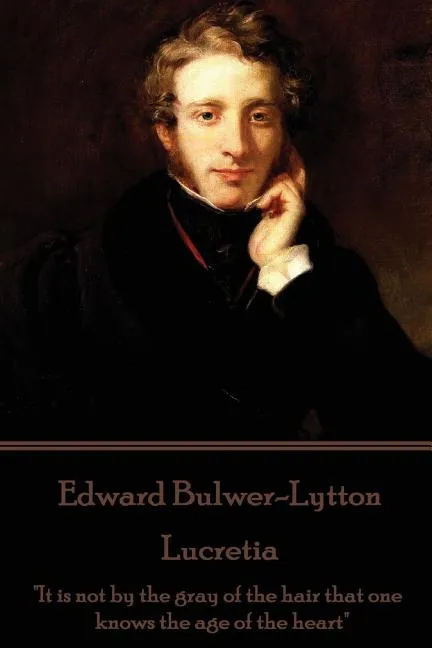
Edward Bulwer-Lytton - Lucretia
"It is not by the gray of the hair that one knows the age of the heart"
Report an issue
Tell us what's wrong and we'll take a look.
Thanks – we got it. We'll review and follow up if needed.
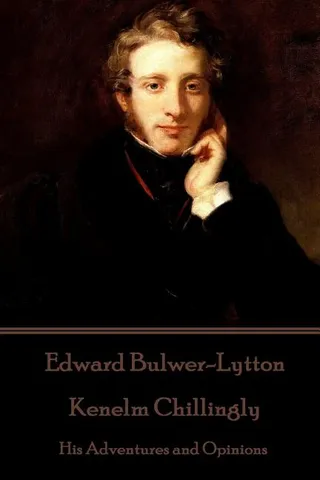
Edward George Earle Bulwer-Lytton was born on May 25th, 1803 the youngest of three sons. When Edward was four his father died and his mother moved the family to London. As a child he was delicate and neurotic and failed to fit in at any number of boarding schools. However, he was academically and creatively precocious and, as a teenager, he published his first work; Ishmael and Other Poems in 1820. In 1822 he entered university at Cambridge and in 1825 he won the Chancellor's Gold Medal for English verse for Sculpture. The following year he received his B.A. degree and printed, for private circulation, the small volume of poems, Weeds and Wild Flowers. During his career he was to be extremely prolific and write across a number of genres; historical fiction, mystery, romance, the occult, and science fiction as well as poetry. In 1828 his novel, Pelham, brought him an income, as well as a commercial and critical reputation. The books intricate plot and humorous, intimate portrayals kept many a gossip busy trying to pair up public figures with characters in the book. Bulwer-Lytton reached, perhaps, the height of his popularity with the publication of Godolphin (1833), followed by The Pilgrims of the Rhine (1834), The Last Days of Pompeii (1834), Rienzi, Last of the Roman Tribunes (1835), and Harold, the Last of the Saxons (1848). In 1841, he started the Monthly Chronicle, a semi-scientific magazine. The Victorian era was filled with many magazines and periodicals all of whom had a great fascination to chronicle and publish the many things that the Empire and Industrial Revolution were discovering, inventing and changing. In 1858 he entered Lord Derby's government as Secretary of State for the Colonies. He took an active interest in the development of the Crown Colony of British Columbia and wrote with great passion to the Royal Engineers upon assigning them their duties there. In 1866 Bulwer-Lytton was raised to the peerage as Baron Lytton of Knebworth in the County of Hertford but his passion for politics now somewhat dimmed. Bulwer-Lytton had long suffered with a disease of the ear and for the last two or three years of his life he lived in Torquay nursing his health. An operation to cure his deafness resulted in an abscess forming in his ear which later burst. Edward George Earle Bulwer-Lytton endured intense pain for a week and died at 2am on January 18th, 1873, in Torquay, just short of his 70th birthday.
Edward Bulwer Lytton Lytton
Edward George Earle Lytton Bulwer Lytton, 1st Baron Lytton, was an influential English writer and politician born on May 25, 1803, in London. A prolific author, he is best known for his novels, including The Last Days of Pompeii, Eugene Aram, and The Coming Race, which helped shape Victorian literature. His writing often explored themes of social issues, human nature, and the tension between reason and emotion. In addition to his literary career, Bulwer Lytton had a notable political life. He served as a Member of Parliament for the Whig Party from 1831 to 1841 and later as a Conservative from 1851 to 1866. He was also appointed to the House of Lords in 1866. Throughout his career, he was awarded the Chancellor's Gold Medal for his contributions to literature. He passed away on January 18, 1873, in Torquay at the age of 69. Bulwer Lytton's legacy endures through his literary works, which continue to influence modern storytelling, and his role in 19th-century politics.
More by Edward Bulwer Lytton Lytton








Why Readwise Books?
Readwise Books is an ebook & audiobook platform that automatically logs how much you and your friends read, making it fun and easy to read more. Learn more →