Report an issue
Tell us what's wrong and we'll take a look.
Thanks – we got it. We'll review and follow up if needed.
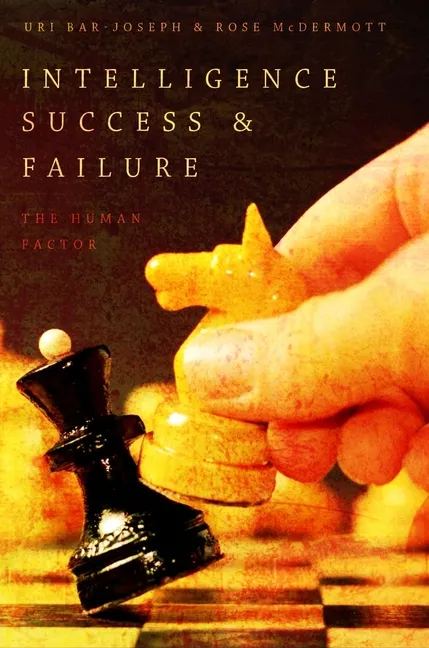
Intelligence Success and Failure challenges this common assertion that catastrophic surprise attacks are the unmistakable products of warning failure alone. Further, Uri Bar-Joseph and Rose McDermott approach this topic uniquely by highlighting the successful cases of strategic surprise, as well as the failures, from a psychological perspective. This book delineates the critical role of individual psychopathologies in precipitating failure by investigating important historical cases.
Bar-Joseph and McDermott use six particular military attacks as examples for their analysis, including: "Barbarossa," the June 1941 German invasion of the USSR (failure); the fall-winter 1941 battle for Moscow (success); the Arab attack on Israel on Yom Kippur 1973 (failure); and the second Egyptian offensive in the war six days later (success). From these specific cases and others, they analyze the psychological mechanisms through which leaders assess their own fatal mistakes and use the intelligence available to them. Their research examines the factors that contribute to failure and success in responding to strategic surprise and identify the learning process that central decision makers use to facilitate subsequent successes.
Intelligence Success and Failure presents a new theory in the study of strategic surprise that claims the key explanation for warning failure is not unintentional action, but rather, motivated biases in key intelligence and central leaders that null any sense of doubt prior to surprise attacks.
Uri Bar-Joseph
Uri Bar-Joseph is Professor of Political Science at the University of Haifa. He is the author of six books about intelligence, Israel's national security strategy, and the Arab-Israeli conflict. His coming book, Intelligence Success and Failure: A Comparative Study (with Rose McDermott), is forthcoming from Oxford University Press.
More by Uri Bar-Joseph





















Why Readwise Books?
Readwise Books is an ebook & audiobook platform that automatically logs how much you and your friends read, making it fun and easy to read more. Learn more →