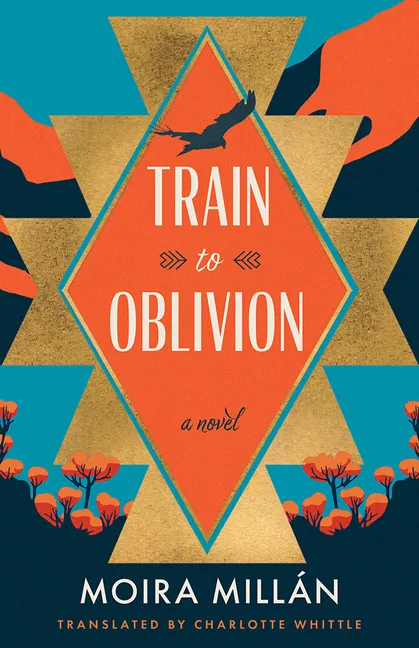
Train to Oblivion
Report an issue
Tell us what's wrong and we'll take a look.
Thanks – we got it. We'll review and follow up if needed.
A dramatic story of love and loss across three generations as the railroad came to Patagonia, forever changing the landscape and its peoples.
Llankaray's grandmother left a rich inheritance: her medicine, an undefeatable spirit, and the stories of her Mapuche ancestors. These tales are forever etched in Llankaray's memory--and the soil of their beloved Patagonia. She begins with Fresia, a gifted Mapuche medicine woman who communicates with plants. She raises her granddaughter, Pirenrayen, to be a strong healer and leader for her people. And then there's Chekeken, a Tehuelche woman who was once kidnapped and sold but escaped. Her son will bear a great lineage. But most unforgettable of all is Pirenrayen, Llankaray's grandmother. Her story collides with the arrival of the railroad in Patagonia--and with a man named Liam O'Sullivan. Born a world away in Dublin, with dreams of becoming a railroad engineer, Liam couldn't be more different from Pirenrayen. But they both witness the oppression of their people under British power. And they find in each other a love for the ages...
Moira Millán
Moira Millán is a weychafe--warrior and defender--of the Mapuche Nation people. The daughter of railroad workers, she was born in the Chubut province of Argentina. She cofounded the October 11 Mapuche-Tehuelche Organization, which has recovered the territories of several communities and founded the Fight for Work movement. She started the March of Indigenous Women for Good Living, now a rights organization. In 2018 she organized the first indigenous women's parliament. She continues to work on behalf of her people, the Earth, and the environment. Her activism has gained greater visibility in recent years amid ongoing repression in Patagonia. In 2012 she won the third DocTV Latin America contest as the cowriter of the documentary Pupila de mujer, mirada de tierra, directed by Florencia Copley. She won the Intercontinental Cry Indigenous Reporting Award with her article "Mapuche Motherhood in the Age of Benetton." Train to Oblivion is her debut novel, and she's now at work on the screenplay.
Charlotte Whittle
Translated by
Charlotte Whittle is an editor, writer, and literary translator whose translations include novels by Norah Lange, Jorge Comensal, and Elisa Victoria. Her translation of Norah Lange's People in the Room was longlisted for the Best Translated Book Award and shortlisted for the Warwick Prize for Women in Translation and the Society of Authors First Translation Prize. Her work has been supported by English PEN and Art OMI, and in 2023 she won the Queen Sofía Spanish Institute Translation Prize for Irene Vallejo's Papyrus: The Invention of Books in the Ancient World. She holds degrees from Oxford, Brown, and UEA, and divides her time between England and New York.


Why Readwise Books?
Readwise Books is an ebook & audiobook platform that automatically logs how much you and your friends read, making it fun and easy to read more. Learn more →