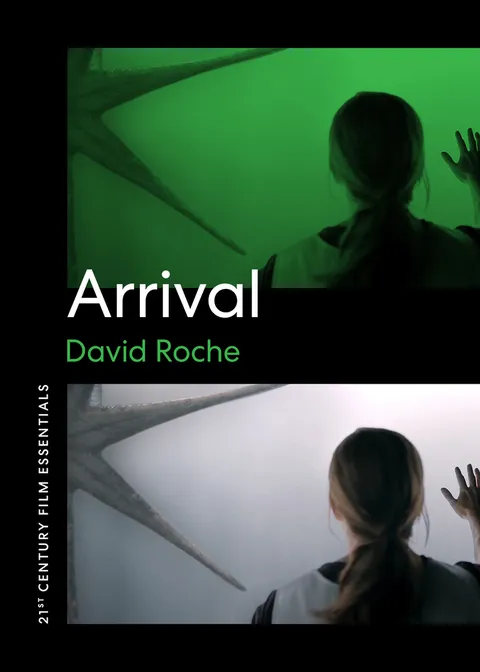
Arrival
Report an issue
Tell us what's wrong and we'll take a look.
Thanks – we got it. We'll review and follow up if needed.
A study of Denis Villeneuve's genre-transcendent film.
In Denis Villeneuve's Arrival (2016), scientists must decipher the language of and peacefully communicate with aliens who have landed on Earth before the world's military attacks. In this first book-length study of the film, scholar David Roche argues that it is one of the most important films of this century, and the most brilliant science fiction film since Blade Runner. Roche posits Arrival as a blockbuster with artistic ambitions--an argument supported by the film's several Academy Award nominations--and looks closely at how the film engages with theoretical questions posed by contemporary film studies and philosophy alike. Each section explores a central aspect of the film: its status as an auteur adaptation; its relation to the science fiction genre; its themes of communication on narrative and meta-narrative levels; its aesthetics of time and space; and the political and ethical questions it raises. Ultimately, Roche declares Arrival a unique, multifaceted experience in the world of hard science fiction films, placing it in context with works like 2001: A Space Odyssey, Close Encounters of the Third Kind, and Contact while also examining how it bridges the gap between genre and art house cinema.
David Roche
David Roche is professor of film studies at the Paul Valéry University of Montpellier. He is author of Making and Remaking Horror in the 1970s and 2000s: Why Don't They Do It Like They Used To? and Quentin Tarantino: Poetics and Politics of Cinematic Metafiction, editor of Conversations with Russell Banks, and coeditor of Comics and Adaptation, all published by University Press of Mississippi.
More by David Roche



Why Readwise Books?
Readwise Books is an ebook & audiobook platform that automatically logs how much you and your friends read, making it fun and easy to read more. Learn more →