Report an issue
Tell us what's wrong and we'll take a look.
Thanks – we got it. We'll review and follow up if needed.
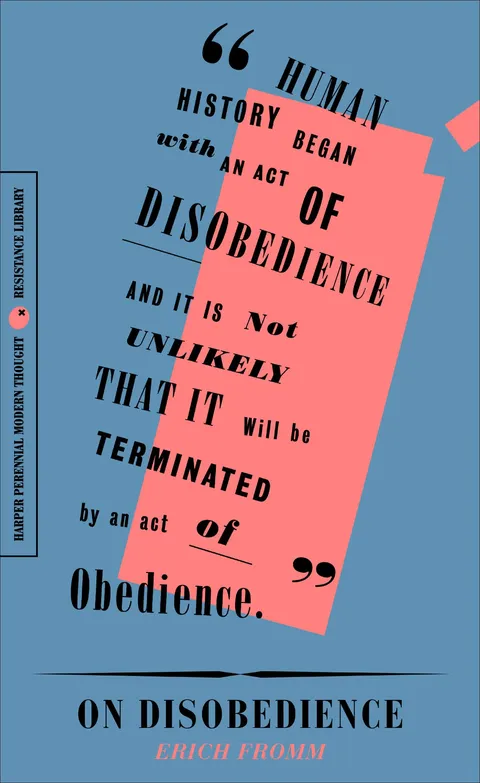
"Human history began with an act of disobedience, and it is not unlikely that it will be terminated by an act of obedience."--from On Disobedience
One of the great psychological and social philosophers of the twentieth century, Erich Fromm expounded on the importance of disobedience and the authentic voice of the individual in modern culture. As relevant now as when it was first published, On Disobedience is a collection of provocative essays, including the title entry, which suggests the very act of dissent--the choice to refuse to conform, to speak "no" to those in power--is essential to a humane society, both to ensure humankind's preservation and to allow for one person to reclaim a genuine sense of self.
In On Disobedience, Fromm writes that the authoritarian dictatorships of the 20th century produced an "organization man" to follow directives blindly, no matter how abhorrent. At the same time, a kind of conformity has arisen in western democracies, only brought about by more subtle means of massive consumerism. In democracies, where the power to implement irreversible destruction rests in the hands of the few, the individual also needs to retain his ability to dissent and to speak "no" to those in power.
In the face of these conformist pressures in whichever form they take, modern man must seek an authentic expression in order to retain his deepest sense of self. Fromm sees both capitalism and totalitarian communism moving toward a life-denying industrial bureaucracy, and berates the one system for ignoring, the other for betraying, the ideals of a true humanistic socialism in which people take precedence over things, life over property, and work over capital.
Fromm maintains the necessity of the freedom to dissent. Of this form of disobedience, he writes, "it is not primarily an attitude directed against something, but for something: for man's capacity to see, to say what he sees, and to refuse to say what he does not see. To do so he does not need to be aggressive or rebellious; he needs to have his eyes open, to be fully awake."
In times of crisis, the great works of philosophy help us make sense of the world. This book is part of the Harper Perennial Resistance Library, a special five-book series highlighting short classic works of independent thought that illuminate the nature of truth, humanity's dangerous attraction to authoritarianism, the influence of media and mass communication, and the philosophy of resistance--all critical in understanding today's politically charged world.
Erich Fromm
Erich Fromm (1900–1980) was a bestselling psychoanalyst and social philosopher whose views about alienation, love, and sanity in society—discussed in his books such as Escape from Freedom, The Art of Loving, The Sane Society, and To Have or To Be?—helped shape the landscape of psychology in the mid-twentieth century. Fromm was born in Frankfurt, Germany, to Jewish parents, and studied at the universities of Frankfurt, Heidelberg (where in 1922 he earned his doctorate in sociology), and Munich. In the 1930s he was one of the most influential figures at the Frankfurt Institute of Social Research. In 1934, as the Nazis rose to power, he moved to the United States. He practiced psychoanalysis in both New York and Mexico City before moving to Switzerland in 1974, where he continued his work until his death.
More by Erich Fromm









Why Readwise Books?
Readwise Books is an ebook & audiobook platform that automatically logs how much you and your friends read, making it fun and easy to read more. Learn more →