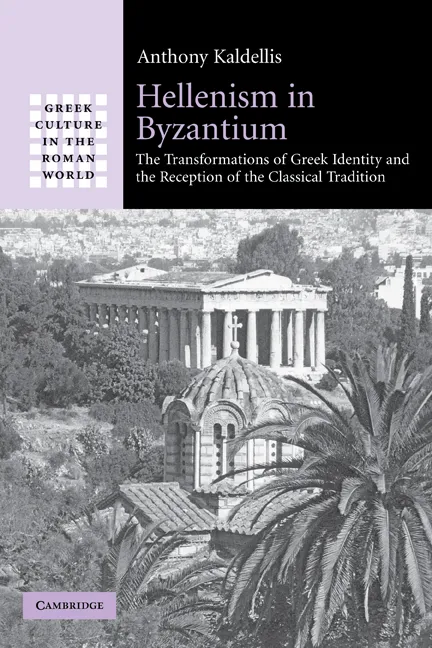
Hellenism in Byzantium
The Transformations of Greek Identity and the Reception of the Classical Tradition
Report an issue
Tell us what's wrong and we'll take a look.
Thanks – we got it. We'll review and follow up if needed.
This text was the first systematic study of what it meant to be 'Greek' in late antiquity and Byzantium, an identity that could alternatively become national, religious, philosophical, or cultural. Through close readings of the sources, Professor Kaldellis surveys the space that Hellenism occupied in each period; the broader debates in which it was caught up; and the historical causes of its successive transformations. The first section (100-400) shows how Romanisation and Christianisation led to the abandonment of Hellenism as a national label and its restriction to a negative religious sense and a positive, albeit rarefied, cultural one. The second (1000-1300) shows how Hellenism was revived in Byzantium and contributed to the evolution of its culture. The discussion looks closely at the reception of the classical tradition, which was the reason why Hellenism was always desirable and dangerous in Christian society, and presents a new model for understanding Byzantine civilisation.
Anthony Kaldellis
Anthony Kaldellis is Professor and Chair of the Department of Classics at The Ohio State University. He is the author of many books, including The Christian Parthenon, Hellenism in Byzantium, and The Byzantine Republic, which have been translated into French, Greek, and Russian.
More by Anthony Kaldellis



Why Readwise Books?
Readwise Books is an ebook & audiobook platform that automatically logs how much you and your friends read, making it fun and easy to read more. Learn more →