Report an issue
Tell us what's wrong and we'll take a look.
Thanks – we got it. We'll review and follow up if needed.
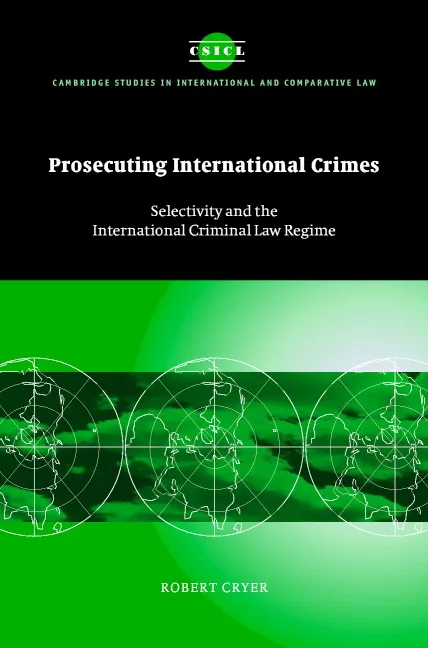
This 2005 book discusses the legitimacy of the international criminal law regime. It explains the development of the system of international criminal law enforcement in historical context, from antiquity through the Nuremberg and Tokyo Trials, to modern-day prosecutions of atrocities in the former Yugoslavia, Rwanda and Sierra Leone. The modern regime of prosecution of international crimes is evaluated with regard to international relations theory. The book then subjects that regime to critique on the basis of legitimacy and the rule of law, in particular selective enforcement, not only in relation to who is prosecuted, but also the definitions of crimes and principles of liability used when people are prosecuted. It concludes that although selective enforcement is not as powerful as a critique of international criminal law as it was previously, the creation of the International Criminal Court may also have narrowed the substantive rules of international criminal law.
Robert Cryer
Robert Cryer is Professor of international and Criminal Law at the University of Birmingham. He has written and edited many books on international law, criminal law and their relationship, and has taught international criminal law for more than twenty years on three continents.
More by Robert Cryer


Why Readwise Books?
Readwise Books is an ebook & audiobook platform that automatically logs how much you and your friends read, making it fun and easy to read more. Learn more →