Report an issue
Tell us what's wrong and we'll take a look.
Thanks – we got it. We'll review and follow up if needed.
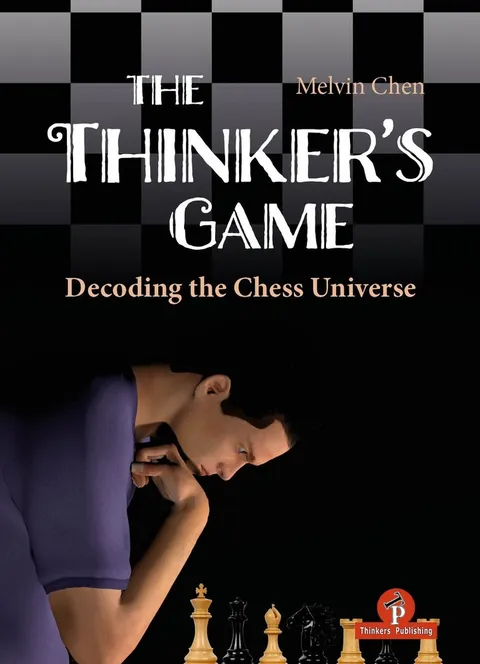
would like to learn more about its various aspects.
It covers the technical
aspects of chess: the use of algebraic notation (Chapter 3), chess evaluation
(Chapter 4), the opening phase (Chapter 5), the middle game (Chapter 6),
the endgame (Chapter 7), and the chess rating system (Chapter 8). It introduces
a number of chess problems, formulated with a chess board and chess
pieces and presupposing a working knowledge of chess (Chapter 9).
It offers
an account of variants of chess such as Fischer random chess (Chapter 10).
It also covers the cultural aspects of chess: its history (Chapter 2) and status
as an immortal game that might enable it to play a role in the search for
extraterrestrial intelligence (Chapter 11). Wherever possible, chess diagrams
are provided to help chess beginners make sense of certain points about chess.
Algebraic notation will also guide them in understanding certain chess-based
lines of reasoning.
Whenever you are ready, let us begin this odyssey of
chess!
Chen
Zhe-Sheng Chen opened the St. John's University's first cancer pharmacology laboratory. His research interest is multidrug resistance and its reversal, novel anti-cancer drug development. Chen serves as Editor of "African Journal of Pharmacy and Pharmacology"; Editor-in-Chief of "Journal of Cancer Research Updates" and "Journal of New Developments in Chemistry". He also serves as an Editorial Board member of 25 journals, an Ad Hoc reviewer of 180 journals, and a guest editor of "Current Pharmaceutical Biotechnology", "Cancer" and "Journal of International Medical Research". Chen has over 170 papers published, 6 book chapters, and 5 patents.
More by Chen









Why Readwise Books?
Readwise Books is an ebook & audiobook platform that automatically logs how much you and your friends read, making it fun and easy to read more. Learn more →