Report an issue
Tell us what's wrong and we'll take a look.
Thanks – we got it. We'll review and follow up if needed.
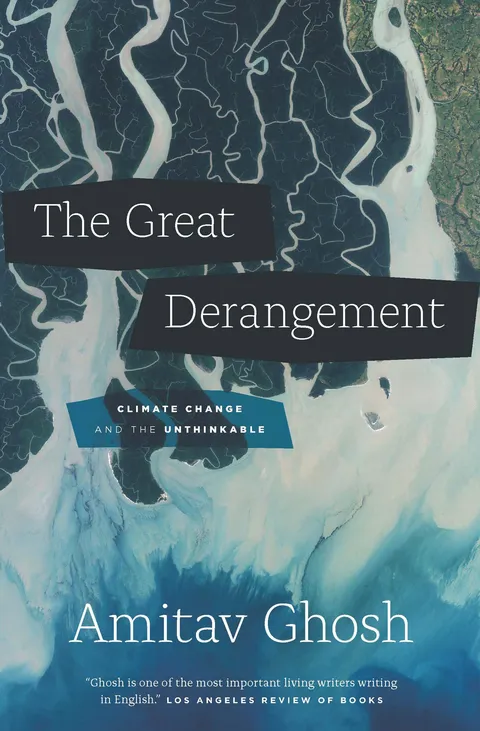
The extreme nature of today's climate events, Ghosh asserts, make them peculiarly resistant to contemporary modes of thinking and imagining. This is particularly true of serious literary fiction: hundred-year storms and freakish tornadoes simply feel too improbable for the novel; they are automatically consigned to other genres. In the writing of history, too, the climate crisis has sometimes led to gross simplifications; Ghosh shows that the history of the carbon economy is a tangled global story with many contradictory and counterintuitive elements.
Ghosh ends by suggesting that politics, much like literature, has become a matter of personal moral reckoning rather than an arena of collective action. But to limit fiction and politics to individual moral adventure comes at a great cost. The climate crisis asks us to imagine other forms of human existence--a task to which fiction, Ghosh argues, is the best suited of all cultural forms. His book serves as a great writer's summons to confront the most urgent task of our time.
Amitav Ghosh
Amitav Ghosh was born in Calcutta in 1956 and raised and educated in Bangladesh, Sri Lanka, Iran, Egypt, India, and the United Kingdom, where he received his Ph.D. in social anthropology from Oxford. Acclaimed for fiction, travel writing, and journalism, his books include The Circle of Reason, The Shadow Lines, In an Antique Land, and Dancing in Cambodia. Ghosh has won France's Prix Medici Etranger, India's prestigious Sahitya Akademi Award, the Arthur C. Clarke Award, and the Pushcart Prize. He now divides his time between Harvard University, where he is a visiting professor, and his homes in India and Brooklyn, New York.
More by Amitav Ghosh


Why Readwise Books?
Readwise Books is an ebook & audiobook platform that automatically logs how much you and your friends read, making it fun and easy to read more. Learn more →