Intellectual Life
Report an issue
Tell us what's wrong and we'll take a look.
Thanks – we got it. We'll review and follow up if needed.
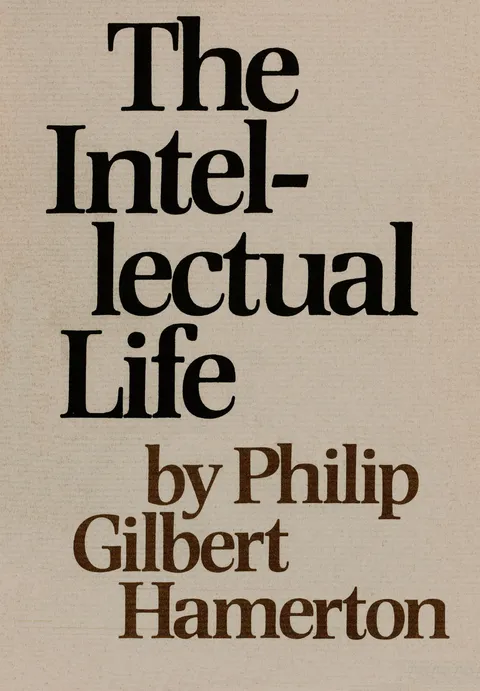
No subsequent work fully compares to this rare mixture of personal insight, ethics, taste, psychology, and common sense. Philip Gilbert Hamerton bestowed upon it his long experience as a writer and artist, his enviable breadth of knowledge, and his elegance of literary style. The result is a remarkable work, expressing intimately the mind and personality of the author, yet universal in its application to all those with a love of intellectual pursuits. The publisher takes a great deal of pleasure in offering this work to the public.
The author consistently rejects simple, dogmatic views, encouraging balance and moderation. He writes, "We need society, and we need solitude also, as we need summer and winter, exercise and rest." There is criticism of both aristocracy and democracy: culture leads one away from class concerns, but one must equally beware the democrat's intolerant tendency to degrade all to the least common denominator.
The book is organized as a series of letters addressed to individuals in a variety of situations. This permits a balanced and insightful work.
Philip Gilbert Hamerton
Philip Gilbert Hamerton was born on September 10, 1834, and died on November 4, 1894. Philip Gilbert Hamerton was an English artist, art reviewer, and author. He wrote a lot about the visual arts because he was a big supporter of modern printmaking. He came up with some important ideas about the English Etching Revival. Hamerton was born in Lancashire, England, in the town of Laneside, which is close to Shaw and Crompton. His mother died while giving birth to him, and ten years later, his father died. He moved in with his two aunts at an estate called the Hollins on the edge of Burnley when he was about five years old. He went to Burnley Grammar School there. Hamerton's first attempt at writing, a collection of poems, failed, so he focused on painting landscapes for a while. He camped out in the Scottish Highlands and eventually rented the former island of Inistrynich in Loch Awe, where he settled with his wife Eugénie Gindriez, who was the daughter of a French republican judge, in 1858. After a while, he realized that writing about art was more his forte than painting, so he went to Sens and then to Autun, where he wrote Painter's Camp in the Highlands (1863), a huge hit that paved the way for his famous book Etching and Etchers (1866).
More by Philip Gilbert Hamerton


Why Readwise Books?
Readwise Books is an ebook & audiobook platform that automatically logs how much you and your friends read, making it fun and easy to read more. Learn more →