Report an issue
Tell us what's wrong and we'll take a look.
Thanks – we got it. We'll review and follow up if needed.
A New York Times Notable Book!
A New York Times Book Review Editors' Choice
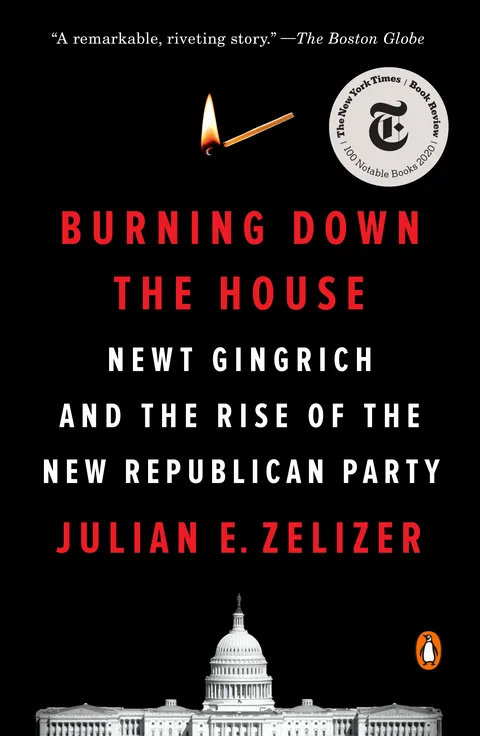
The story of how Newt Gingrich and his allies tainted American politics, launching an enduring era of brutal partisan warfare
When Donald Trump was elected president in 2016, President Obama observed that Trump “is not an outlier; he is a culmination, a logical conclusion of the rhetoric and tactics of the Republican Party.” In Burning Down the House, historian Julian Zelizer pinpoints the moment when our country was set on a path toward an era of bitterly partisan and ruthless politics, an era that was ignited by Newt Gingrich and his allies. In 1989, Gingrich brought down Democratic Speaker of the House Jim Wright and catapulted himself into the national spotlight. Perhaps more than any other politician, Gingrich introduced the rhetoric and tactics that have shaped Congress and the Republican Party for the last three decades. Elected to Congress in 1978, Gingrich quickly became one of the most powerful figures in America not through innovative ideas or charisma, but through a calculated campaign of attacks against political opponents, casting himself as a savior in a fight of good versus evil. Taking office in the post-Watergate era, he weaponized the good government reforms newly introduced to fight corruption, wielding the rules in ways that shocked the legislators who had created them. His crusade against Democrats culminated in the plot to destroy the political career of Speaker Wright.
While some of Gingrich’s fellow Republicans were disturbed by the viciousness of his attacks, party leaders enjoyed his successes so much that they did little collectively to stand in his way. Democrats, for their part, were alarmed, but did not want to sink to his level and took no effective actions to stop him. It didn’t seem to matter that Gingrich’s moral conservatism was hypocritical or that his methods were brazen, his accusations of corruption permanently tarnished his opponents. This brand of warfare worked, not as a strategy for governance but as a path to power, and what Gingrich planted, his fellow Republicans reaped. He led them to their first majority in Congress in decades, and his legacy extends far beyond his tenure in office. From the Contract with America to the rise of the Tea Party and the Trump presidential campaign, his fingerprints can be seen throughout some of the most divisive episodes in contemporary American politics. Burning Down the House presents the alarming narrative of how Gingrich and his allies created a new normal in Washington.
Julian E. Zelizer
Julian E. Zelizer, Ph.D., is a Professor of History at Boston University. He is author of ON CAPITOL HILL: THE STRUGGLE TO REFORM CONGRESS AND ITS CONSEQUENCES, 1948-2000, Taxing America: Wilbur D. Mills, Congress, and the State 1945-1975 (Cambridge Univ. Press, 1998), which won the Organization of American Historian's 2000 Ellis Hawley Prize and the Lyndon B. Johnson Foundation's 1998 D.B. Hardeman Prize. He is author of dozens of publications, articles, book chapters, and book reviews on American government, esp. Congress, and is a prominent young scholar in the American history world.
More by Julian E. Zelizer


Why Readwise Books?
Readwise Books is an ebook & audiobook platform that automatically logs how much you and your friends read, making it fun and easy to read more. Learn more →