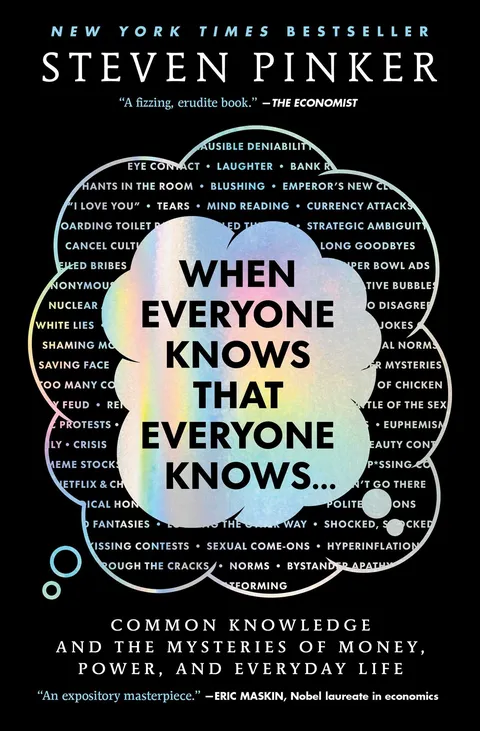
When Everyone Knows That Everyone Knows . . .
Common Knowledge and the Mysteries of Money, Power, and Everyday Life
Report an issue
Tell us what's wrong and we'll take a look.
Thanks – we got it. We'll review and follow up if needed.
From one of the world’s most celebrated intellectuals, a “fascinating” (Financial Times), brilliantly insightful work that explains how we think about each other’s thoughts about each other’s thoughts, ad infinitum.
It sounds impossible, but Steven Pinker shows that we do it all the time. This awareness is called common knowledge, and it has a momentous impact on our social, political, and economic lives.
Common knowledge is necessary for coordination, for making arbitrary but complementary choices like driving on the right and coalescing behind a political leader or movement. It’s also necessary for social coordination: everything from meeting up at a time and place to forming enduring bonds of friendship, romance, or authority. Humans have a sixth sense for common knowledge, and we create it with signals like laughter, tears, blushing, eye contact, and blunt speech.
But people also may strive to avoid common knowledge—to ensure that even if everyone knows something, they can’t know that everyone else knows they know it. And so we get rituals like benign hypocrisy, veiled bribes and threats, sexual innuendo, and pretending not to see the elephant in the room.
Pinker shows how the hidden logic of common knowledge can make sense of many of life’s enigmas: financial bubbles and crashes, revolutions that seem to come from out of nowhere, the eruption of cancel culture, and even the awkwardness of a first date.
Steven Pinker
STEVEN PINKER is a pioneering cognitive scientist who has written a number of of bestselling books, including The Sense of Style: The Thinking Person's Guide to Writing in the 21st Century, as well as the landmark study on human progress The Better Angels of Our Nature, which won the New York Times Book Review Notable Book of the Year Award and was chosen for Mark Zuckerberg's book club. The Blank Slate and How the Mind Works were both finalists for the Pulitzer Prize. He is Johnstone Family Professor of Psychology at Harvard and has been named by Time magazine as one of the "100 Most Influential People in the World."
More by Steven Pinker














Why Readwise Books?
Readwise Books is an ebook & audiobook platform that automatically logs how much you and your friends read, making it fun and easy to read more. Learn more →