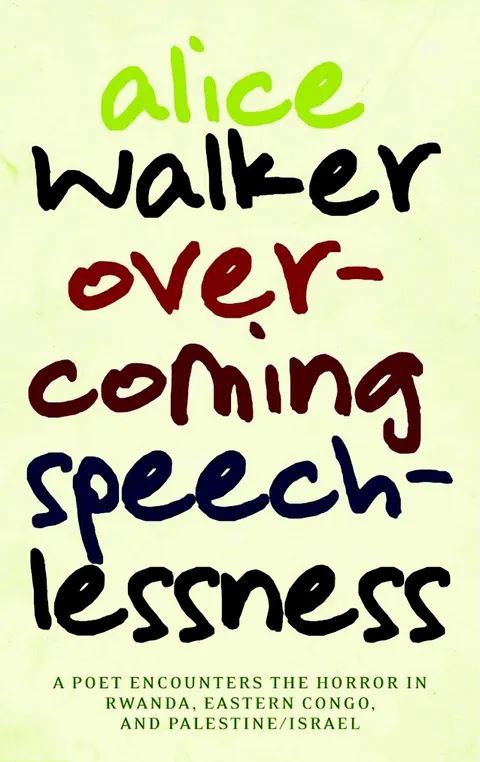
Overcoming Speechlessness
A Poet Encounters the Horror in Rwanda, Eastern Congo, and Palestine/Israel
Report an issue
Tell us what's wrong and we'll take a look.
Thanks – we got it. We'll review and follow up if needed.
In 2006, Alice Walker, working with Women for Women International, visited Rwanda and the eastern Congo to witness the aftermath of the genocide in Kigali. Invited by Code Pink, an antiwar group working to end the Iraq War, Walker traveled to Palestine/Israel three years later to view the devastation on the Gaza Strip. Here is her testimony.
Bearing witness to the depravity and cruelty, she presents the stories of the individuals who crossed her path and shared their tales of suffering and courage. Part of what has happened to human beings over the last century, she believes, is that we have been rendered speechless by unusually barbaric behavior that devalues human life. We have no words to describe what we witness. Self-imposed silence has slowed our response to the plight of those who most need us, often women and children, but also men of conscience who resist evil but are outnumbered by those around them who have fallen victim to a belief in weapons, male or ethnic dominance, and greed.
Alice Walker
Alice Walker (b. 1944), one of the United States’ preeminent writers, is an award-winning author of novels, stories, essays, and poetry. In 1983, Walker became the first African-American woman to win a Pulitzer Prize for fiction with her novel The Color Purple, which also won the National Book Award. Her other novels include The Third Life of Grange Copeland, Meridian, The Temple of My Familiar, and Possessing the Secret of Joy. In her public life, Walker has worked to address problems of injustice, inequality, and poverty as an activist, teacher, and public intellectual.
More by Alice Walker
















Why Readwise Books?
Readwise Books is an ebook & audiobook platform that automatically logs how much you and your friends read, making it fun and easy to read more. Learn more →