Report an issue
Tell us what's wrong and we'll take a look.
Thanks – we got it. We'll review and follow up if needed.
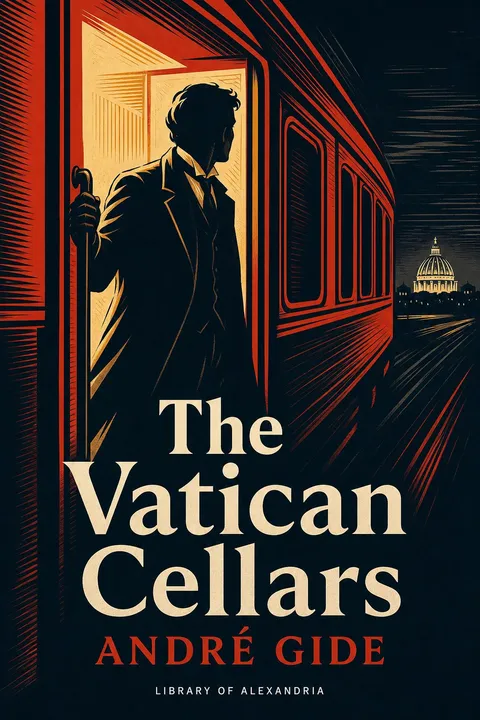
A kidnapped pope, a profitable lie, and a young man testing the limits of morality: belief has dangerous consequences in this darkly comic French novel.
Set largely in Rome and Paris in the 1890s, André Gide's The Vatican Cellars follows an interconnected circle of believers, sceptics, and adventurers caught up in an extraordinary fraud. Con men claim that Pope Leo XIII has been abducted by Freemasons and imprisoned beneath the Vatican. Secret donations, they insist, are the only way to rescue him. For the credulous provincial Amédée Fleurissoire, the story becomes a summons to a bewildering mission.
Meanwhile, the scientist Anthime Armand-Dubois undergoes a startling religious conversion, and the Catholic novelist Julius de Baraglioul wrestles with the possibility of an act performed without motive. The morally indifferent young Lafcadio Wluiki gives that idea a disturbing reality. Calling his work a sotie, or satirical farce, Gide brings social comedy into contact with unsettling questions about guilt and responsibility. Its enduring bite lies in the distance between what people profess to believe and what they permit themselves to do.
What readers find inside:
- A papal conspiracy - An invented captivity exposes the ease with which devotion can be exploited.
- A bewildered pilgrim - Fleurissoire's attempt to save the Pope turns pious purpose into anxious, uncomfortable comedy.
- The gratuitous act - The possibility of action without motive challenges familiar explanations of human conduct.
- Interlocking lives - Scientists, novelists, swindlers, and adventurers reveal competing forms of certainty and self-deception.
- Comedy with consequences - Bourgeois respectability and religious conviction meet an irony that grows increasingly unsettling.
For readers of French classics, dark social comedy, and philosophical fiction, this is a novel that invites laughter without allowing moral comfort. Its questions about belief and rationalisation remain sharply recognisable.
Step into Gide's web of faith and deception, where an absurd rumour opens onto a serious moral abyss.
André Gide
André Gide (1869–1951), winner of the 1947 Nobel Prize for Literature, was a celebrated novelist, dramatist, and essayist whose narrative works dealt frankly with homosexuality and the struggle between artistic discipline, moralism, and sensual indulgence. Born in Paris, Gide became an influential intellectual figure in nineteenth- and twentieth-century French literature and culture. His essay collections Autumn Leaves and Oscar Wilde, among others, contributed to the public’s understanding of key figures of the day. He traveled widely and advocated for the rights of prisoners, denounced the conditions in the African colonies, and became a voice for, and then against, communism. Other notable works include The Notebooks of André Walter (1891), Corydon (1924), If It Die (1924), The Counterfeiters, and his journals, Journal 1889–1939, Journal 1939–1942, and Journal 1942–1949.
More by André Gide









Why Readwise Books?
Readwise Books is an ebook & audiobook platform that automatically logs how much you and your friends read, making it fun and easy to read more. Learn more →