Report an issue
Tell us what's wrong and we'll take a look.
Thanks – we got it. We'll review and follow up if needed.
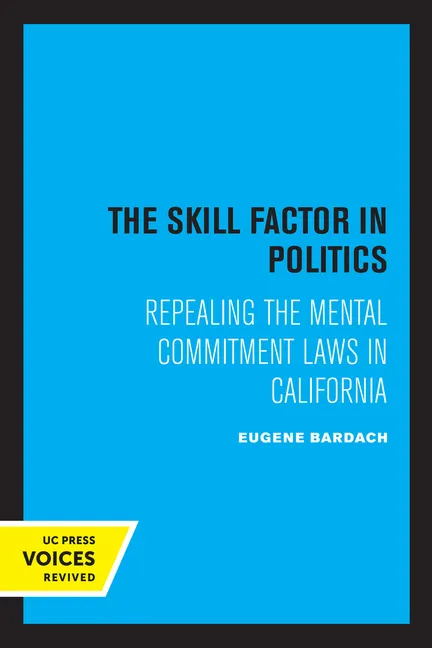

Eugene Bardach's The Skill Factor in Politics: Repealing the Mental Commitment Laws in California uses the 1965–67 overhaul of California's involuntary commitment system to explore what political skill actually is—and how it determines outcomes. Tracking a reform coalition that most observers initially rated as long-shots (and briefly wrote off for dead) before it ultimately prevailed, Bardach argues that standard political science couldn't explain the win because it lacked a workable theory of "skill." Rather than treating skill as a personality trait, he defines it as a quality of action in problem-solving—timely, efficient, inventive maneuvers tailored to the structure of a policy contest. His evidence comes from close observation of the commitment reform and four comparative cases in California mental health politics (an interdepartmental turf struggle, an internal DMH controversy, a licensing fight over psychotherapy, and a state-hospital budget battle), supplemented by interviews, documents, and a survey of the "attentive public." From these cases Bardach sketches a pragmatic model of policy entrepreneurship. Success equals authorization by relevant authorities, which depends on assembling "enough" support from strategically weighted interests. The entrepreneur's four core problems are: (1) designing proposals and plausible alternatives that can attract the right mix of interests; (2) recruiting and activating a coalition with resources (persuasion, information, venues, procedural leverage) to build that support; (3) defending and countering opposition through timing, sabotage, and agenda control; and (4) sustaining organizational capacity—managing attention, sequencing moves, and adapting doctrine as events unfold. Bardach's aim isn't to rank skill above other forces, but to make it visible and teachable as craft. He closes by urging broader diffusion of these skills—among analysts, citizen-advocates, and officials—arguing that representative institutions work best when more participants can map the field, diagnose leverage points, and execute creative, well-timed political action. This title is part of UC Press's Voices Revived program, which commemorates University of California Press's mission to seek out and cultivate the brightest minds and give them voice, reach, and impact. Drawing on a backlist dating to 1893, Voices Revived makes high-quality, peer-reviewed scholarship accessible once again using print-on-demand technology. This title was originally published in 1972.
Many titles in the Voices Revived program are also newly available as ebooks, offered at a discounted price to support wider access to scholarly work.
Eugene Bardach
Eugene Bardach has been teaching graduate-level policy analysis workshop classes since 1973 at the Goldman School of Public Policy, University of California, Berkeley, in which time he has coached some five hundred projects. He is a broadly based political scientist with wide-ranging teaching and research interests. His focus is primarily on policy implementation and public management, and most recently on problems of facilitating better interorganizational collaboration in service delivery (e.g., in human services, environmental enforcement, fire prevention, and habitat preservation). He also maintains an interest in problems of homeland defense, as well as regulatory program design and execution, particularly in areas of health, safety, consumer protection, and equal opportunity. Bardach has developed novel teaching methods and materials at Berkeley, has directed and taught in residentially based training programs for higher-level public managers, and has worked for the Office of Policy Analysis at the US Department of the Interior. He is the recipient of the 1998 Donald T. Campbell Award of the Policy Studies Organization for creative contribution to the methodology of policy analysis, and is a fellow of the American Academy of Arts and Sciences. This book is based on his experience teaching students the principles of policy analysis and then helping them to execute their project work.
More by Eugene Bardach


Why Readwise Books?
Readwise Books is an ebook & audiobook platform that automatically logs how much you and your friends read, making it fun and easy to read more. Learn more →