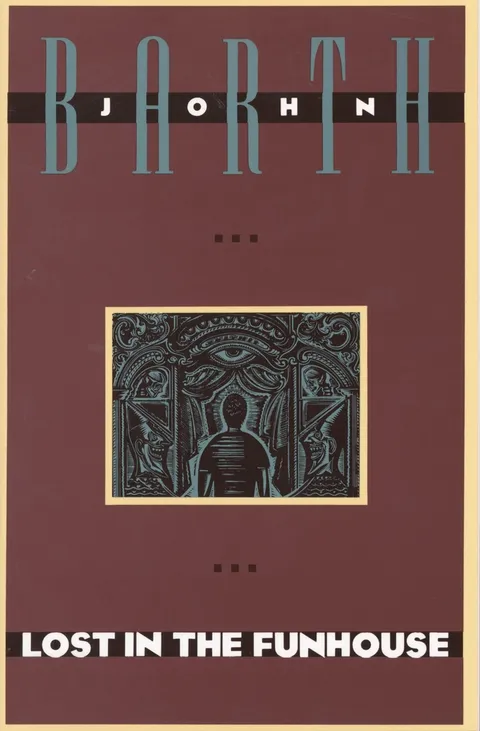
Lost in the Funhouse (National Book Award Finalist)
Report an issue
Tell us what's wrong and we'll take a look.
Thanks – we got it. We'll review and follow up if needed.
"[Barth] ran riot over literary rules and conventions, even as he displayed, with meticulous discipline, mastery of and respect for them." --The New York Times
From its opening story, "Frame-Tale"--printed sideways and designed to be cut out by the reader and twisted into a never-ending Mobius strip--to the much-anthologized "Life-Story," whose details are left to the reader to "fill in the blank," Barth's acclaimed collection challenges our ideas of what fiction can do. Highlights include the Homerian story-wthin-a-story-within-a-story (times seven) of "Menalaiad, ' and "Night-Sea Journey," a first-person account of a confused human sperm on its way to fertilize an egg. All of the characters in Lost in the Funhouse are searching, in one way or another, for their purpose and the meaning of their existence. Together, their stories form a kaleidescope of exuberant metafictional inventiveness.
John Barth
John Barth is our most celebrated postmodernist. From the appearance in 1956 of The Floating Opera, his first published book, through the essay collection Final Fridays, released in 2012, he has published at least two books in each of the seven decades spanning his writerly life thus far. Thrice nominated for the National Book Award--The Floating Opera, Lost in the Funhouse, and Chimera, which won in 1973--Barth has received the F. Scott Fitzgerald Award for Outstanding Achievement in American Fiction, the PEN/Malamud Award for Excellence in the Short Story, and the Lannan Foundation Lifetime Achievement Award. A native of Maryland's Eastern Shore, he taught for twenty-two years in the Writing Seminars at Johns Hopkins University. He now lives in Florida with his wife Shelly.
More by John Barth


Why Readwise Books?
Readwise Books is an ebook & audiobook platform that automatically logs how much you and your friends read, making it fun and easy to read more. Learn more →