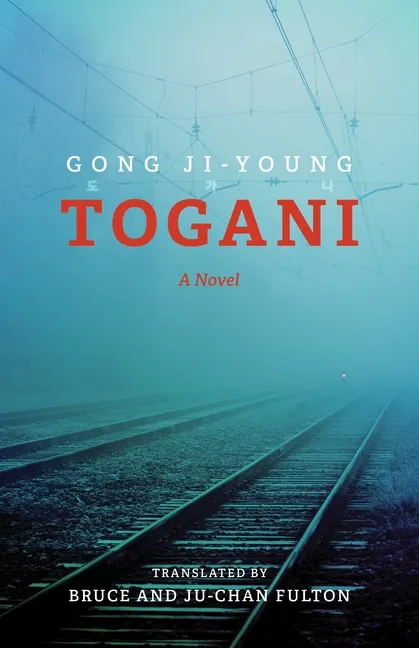
Togani
Report an issue
Tell us what's wrong and we'll take a look.
Thanks – we got it. We'll review and follow up if needed.
Atmospheric and fast-paced, this novel of manners set in a provincial South Korean city leads readers through the silent corridors of a school for hearing-impaired children and the city's foggy back streets and murky centers of power to a stirring courtroom climax. Gong Ji-young's Togani (The Crucible), published in Korean in 2009, is based on a historic case of child sexual abuse at a state-run institution. The novel went on to sell nearly a million copies and, along with a 2011 film adaptation directed by Hwang Dong-hyuk, prompted the South Korean National Assembly to pass the "Togani Laws" to provide greater legal protections for children and vulnerable adults under state care and harsher penalties for those convicted of their abuse. At a time when Korean popular culture drives cultural production worldwide, Togani reminds us of the power of fiction to effect meaningful societal change.
A story of courage in the face of corruption, Togani offers nuanced portraits of a failed young businessman seeking a new life as a teacher and his counterpart, a young woman committed to a career in human rights; a police officer of humble origins who rose through the ranks as he turns a blind eye to the abuse of students by the school's administrators; and a hearing-impaired teenage girl, a victim of that abuse, who cares deeply for the other children at the school. The book testifies to the legacy of neo-Confucian class conflict, gender disparity, and the vulnerability of those near the bottom of the social ladder. It is a heart-wrenching and provocative work that helped bring about change to a system it dared to challenge.
Ji-Young Gong
Gong Ji-young is a household name in Korea and Korean communities abroad, respected for her dedication to gender equality and human rights. Born in Seoul, Gong graduated from Yonsei University with a degree in English literature. Her first published works were poems, but she has since devoted herself to fiction, publishing numerous novels and story collections.
More by Ji-Young Gong
Bruce Fulton
Translated by
Bruce Fulton is the inaugural holder of the Young-Bin Min Chair in Korean Literature and Literary Translation, Department of Asian Studies, University of British Columbia. For their translation of One Left, Bruce and Ju-Chan Fulton received an America PEN Heim Translation Grant, only the second such award for a Korean project. The Fultons have translated numerous volumes of modern Korean fiction, including the award-winning women's anthology Words of Farewell: Stories by Korean Women Writers (Seal Press, 1989), with Marshall R. Pihl, Land of Exile: Contemporary Korean Fiction, rev. and exp. ed. (M.E. Sharpe, 2007) Sunset: A Ch'ae Manshik Reader (Columbia University Press, 2017). Bruce Fulton is also co-translator (with Kim Chong-un) of A Ready-Made Life: Early Masters of Modern Korean Fiction (University of Hawai'i Press, 1998), co-editor (with Youngmin Kwon) of Modern Korean Fiction: An Anthology (Columbia University Press, 2005).
Ju-Chan Fulton
Translated by
For their translation of One Left, Bruce and Ju-Chan Fulton received an America PEN Heim Translation Grant, only the second such award for a Korean project. The Fultons have translated numerous volumes of modern Korean fiction, including the award-winning women's anthology Words of Farewell: Stories by Korean Women Writers (Seal Press, 1989) and, with Marshall R. Pihl, Land of Exile: Contemporary Korean Fiction, rev. and exp. ed. (M.E. Sharpe, 2007). The Fultons have received several awards and fellowships for their translations, including two National Endowment for the Arts Translation Fellowships and a residency at the Banff International Literary Translation Centre, the first ever awarded for translators from any Asian language.


Why Readwise Books?
Readwise Books is an ebook & audiobook platform that automatically logs how much you and your friends read, making it fun and easy to read more. Learn more →