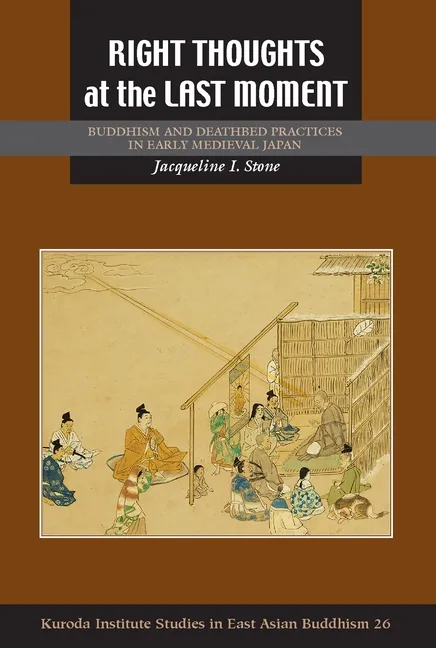
Right Thoughts at the Last Moment
Buddhism and Deathbed Practices in Early Medieval Japan
Report an issue
Tell us what's wrong and we'll take a look.
Thanks – we got it. We'll review and follow up if needed.
Buddhists across Asia have often aspired to die with a clear and focused mind, as the historical Buddha himself is said to have done. This book explores how the ideal of dying with right mindfulness was appropriated, disseminated, and transformed in premodern Japan, focusing on the late tenth through early fourteenth centuries. By concentrating one's thoughts on the Buddha in one's last moments, it was said even an ignorant and sinful person could escape the cycle of deluded rebirth and achieve birth in a buddha's pure land, where liberation would be assured. Conversely, the slightest mental distraction at that final juncture could send even a devout practitioner tumbling down into the hells or other miserable rebirth realms. The ideal of mindful death thus generated both hope and anxiety and created a demand for ritual specialists who could act as religious guides at the deathbed. Buddhist death management in Japan has been studied chiefly from the standpoint of funerals and mortuary rites. Right Thoughts at the Last Moment investigates a largely untold side of that story: how early medieval Japanese prepared for death, and how desire for ritual assistance in one's last hours contributed to Buddhist preeminence in death-related matters. It represents the first book-length study in a Western language to examine how the Buddhist ideal of mindful death was appropriated in a specific historical context.
Practice for one's last hours occupied the intersections of multiple, often disparate approaches that Buddhism offered for coping with death. Because they crossed sectarian lines and eventually permeated all social levels, deathbed practices afford insights into broader issues in medieval Japanese religion, including intellectual developments, devotional practices, pollution concerns, ritual performance, and divisions of labor among religious professionals. They also allow us to see beyond the categories of "old" versus "new" Buddhism, or establishment Buddhism versus marginal heterodoxies, which have characterized much scholarship to date. Enlivened by cogent examples, this study draws on a wealth of sources including ritual instructions, hagiographies, doctrinal writings, didactic tales, courtier diaries, historical records, letters, and relevant art historical material to explore the interplay of doctrinal ideals and on-the-ground practice.
Jacqueline I Stone
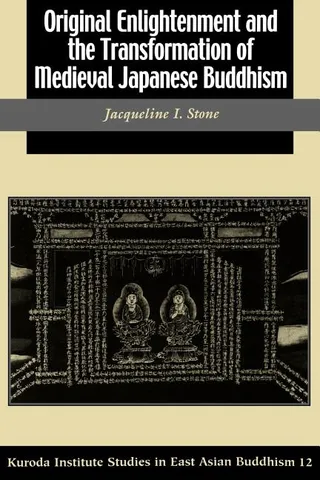
Jacqueline I. Stone (PhD, East Asian Languages and Cultures, UCLA) is Professor of Japanese Religions at Princeton University. She is the author of Original Enlightenment and the Transformation of Medieval Japanese Buddhism (Hawaii, 2001), which won the 2001 American Academy of Religion Award for Excellence in the Study of Religion, and Right Thoughts at the Last Moment-Buddhism and Deathbed Practices in Early Medieval Japan (Hawaii, 2016), and she is the coeditor (with Brian J. Cuevas) of The Buddhist Dead: Practices, Discourses, Representations (Hawaii, 2007) and (witrh Stephen F. Teiser) Readings of the Lotus Sutra (Columbia, 2009). She is a specialist in Japanese Buddhism.
More by Jacqueline I Stone


Why Readwise Books?
Readwise Books is an ebook & audiobook platform that automatically logs how much you and your friends read, making it fun and easy to read more. Learn more →