Report an issue
Tell us what's wrong and we'll take a look.
Thanks – we got it. We'll review and follow up if needed.
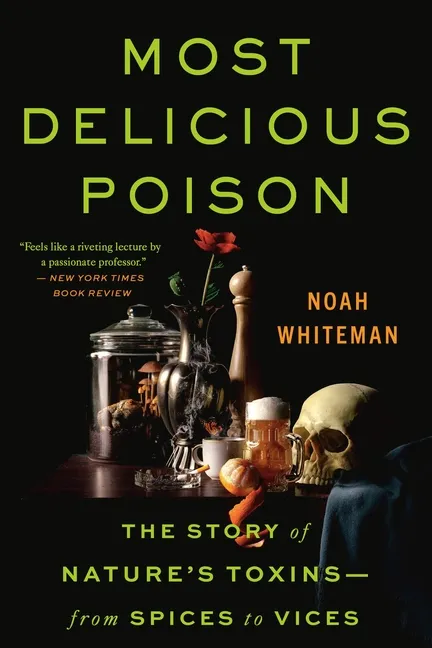
An evolutionary biologist tells the story of nature's toxins and why we are attracted--and addicted--to them.
"A magisterial, fascinating, and gripping tour de force." --Neil Shubin, biology professor and author or Your Inner Fish
A deadly secret lurks within our spice racks, medicine cabinets, backyard gardens, and private stashes.Scratch beneath the surface of a coffee bean, a red pepper flake, a poppy seed, a mold spore, a foxglove leaf, a magic-mushroom cap, a marijuana bud, or an apple seed, and we find a bevy of strange chemicals. We use these to greet our days (caffeine), titillate our tongues (capsaicin), recover from surgery (opioids), cure infections (penicillin), mend our hearts (digoxin), bend our minds (psilocybin), calm our nerves (CBD), and even kill our enemies (cyanide). But why do plants and fungi produce such chemicals? And how did we come to use and abuse some of them?
Based on cutting-edge science in the fields of evolution, chemistry, and neuroscience, Most Delicious Poison reveals:
- The origins of toxins produced by plants, mushrooms, microbes, and even some animals
- The mechanisms that animals evolved to overcome them
- How a co-evolutionary arms race made its way into the human experience
- And much more
Noah Whiteman
Noah Whiteman is an evolutionary biologist at the University of California, Berkeley, where he is Professor of Integrative Biology and of Molecular and Cell Biology. At Berkeley, he is also affiliated with the Helen Wills Neuroscience Institute, Center for Computational Biology, Museum of Vertebrate Zoology, Jepson and University Herbaria, and Essig Museum of Entomology. He received a Guggenheim Fellowship in 2020 to write Most Delicious Poison and lives in Oakland.





Why Readwise Books?
Readwise Books is an ebook & audiobook platform that automatically logs how much you and your friends read, making it fun and easy to read more. Learn more →