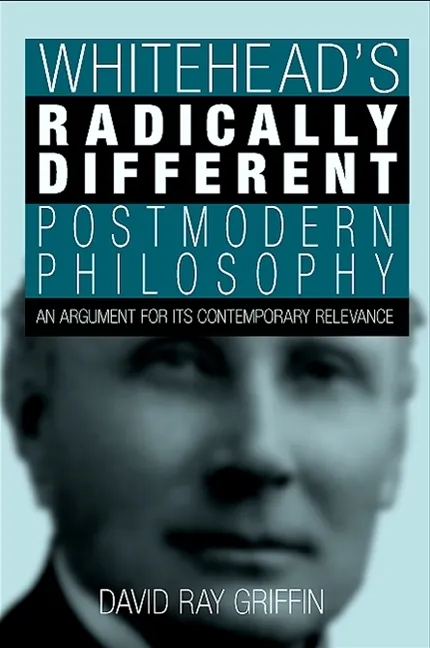
Whitehead's Radically Different Postmodern Philosophy
An Argument for Its Contemporary Relevance
Report an issue
Tell us what's wrong and we'll take a look.
Thanks – we got it. We'll review and follow up if needed.
Examines the postmodern implications of Whitehead's metaphysical system.
Postmodern philosophy is often dismissed as unintelligible, self-contradictory, and as a passing fad with no contribution to make to the problems faced by philosophers in our time. While this characterization may be true of the type of philosophy labeled postmodern in the 1980s and 1990s, David Ray Griffin argues that Alfred North Whitehead had formulated a radically different type of postmodern philosophy to which these criticisms do not apply. Griffin shows the power of Whitehead's philosophy in dealing with a range of contemporary issues-the mind-body relation, ecological ethics, truth as correspondence, the relation of time in physics to the (irreversible) time of our lives, and the reality of moral norms. He also defends a distinctive dimension of Whitehead's postmodernism, his theism, against various criticisms, including the charge that it is incompatible with relativity theory.
David Ray Griffin
David Ray Griffin is Professor of Philosophy of Religion at Claremont School of Theology and Claremont Graduate University. Among his many books are Religion and Scientific Naturalism: Overcoming the Conflicts; Unsnarling the World-Knot: Consciousness, Freedom, and the Mind-Body Problem; and Evil Revisited: Responses and Reconsiderations.
More by David Ray Griffin








Why Readwise Books?
Readwise Books is an ebook & audiobook platform that automatically logs how much you and your friends read, making it fun and easy to read more. Learn more →