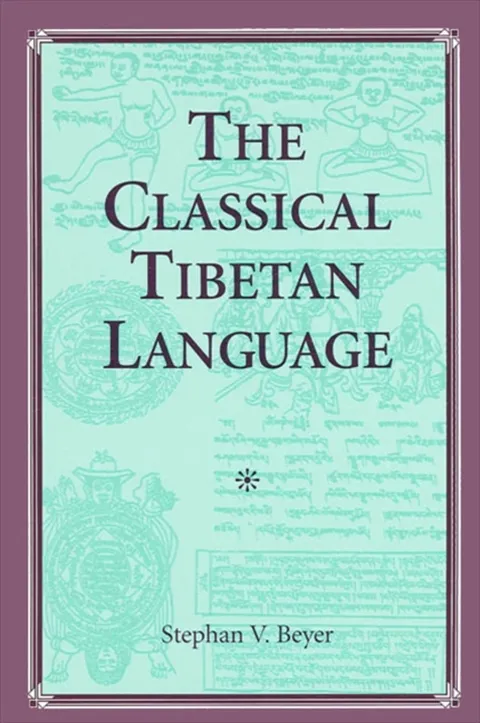
The Classical Tibetan Language
Report an issue
Tell us what's wrong and we'll take a look.
Thanks – we got it. We'll review and follow up if needed.
Among Asian languages, Tibetan is second only to Chinese in the depth of its historical record, with texts dating back as far as the eighth and ninth centuries, written in an alphabetic script that preserves the contemporaneous phonological features of the language.
The Classical Tibetan Language is the first comprehensive description of the Tibetan language and is distinctive in that it treats the classical Tibetan language on its own terms rather than by means of descriptive categories appropriate to other languages, as has traditionally been the case. Beyer presents the language as a medium of literary expression with great range, power, subtlety, and humor, not as an abstract object. He also deals comprehensively with a wide variety of linguistic phenomena as they are actually encountered in the classical texts, with numerous examples of idioms, common locutions, translation devices, neologisms, and dialectal variations.
Stephan V Beyer
Steven Beyer has Ph.D. degrees in religious studies and in psychology, and has taught as an associate professor at the University of Wisconsin, Madison, the University of California, Berkeley, and the Graduate Theological Union. Beyer is an independent scholar doing research and fieldwork in ethnobotany, shamanism, ethnomedicine, and hallucinogenic plants and fungi, with a focus on indigenous and shamanic healing systems and the cognitive psychology of anomalous experiences. His current research centers on concepts of healing and the lived body across cultures, the cross-cultural transmission of ethnomedical systems, the role of alternative medical models, and differing cultural conceptions of herbalism and the healing plants.
More by Stephan V Beyer



Why Readwise Books?
Readwise Books is an ebook & audiobook platform that automatically logs how much you and your friends read, making it fun and easy to read more. Learn more →