Report an issue
Tell us what's wrong and we'll take a look.
Thanks – we got it. We'll review and follow up if needed.
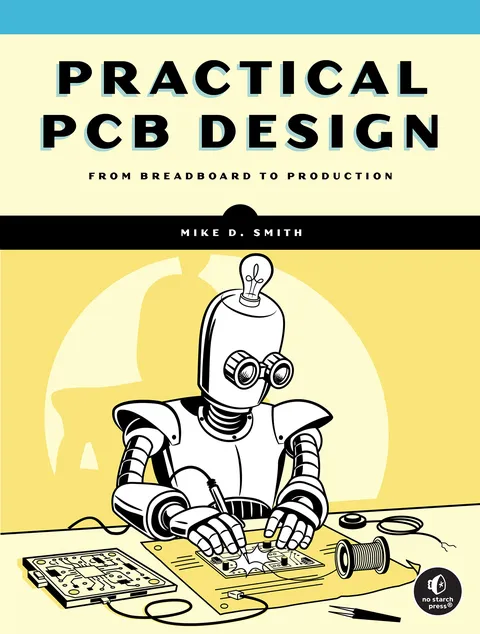
Your circuit works on the breadboard. Now learn the concepts that turn it into a board ready for production.
Moving from a breadboard to a finished circuit board introduces a new set of constraints. Parts need footprints, traces compete for room, and connectors have to fit, all within the manufacturer’s design rules. A mistake that’s a quick fix on a breadboard means another fabrication run once it’s committed to copper.
With Practical PCB Design, you’ll learn to make that transition go smoothly before drawing a single trace and ask the questions a simulation doesn’t: What happens when you approach the voltage rating of that 10 µF ceramic capacitor and it provides only 3 µF? Are you building one board or 10,000, and how does that change specifications?
As you work through the PCB design process, you’ll learn to:
- Account for component tolerance, cost, power, and fit
- Create schematics, component symbols, and footprints from scratch
- Work with copper, solder mask, and silkscreen layers
- Route traces and vias for reliable operation
- Apply design rules and systematic reviews to catch problems before fabrication
- Generate assembly files and order boards with confidence
Every chapter ends with a hands-on exercise that puts these skills into practice. The examples use the free, Windows-based Altium CircuitMaker, but the techniques apply across PCB design tools.
If you can build the circuit, this book will teach you how to build the board.
Requirements: Basic electronics knowledge and PCB design software. No fabrication, soldering, or test equipment required.





Why Readwise Books?
Readwise Books is an ebook & audiobook platform that automatically logs how much you and your friends read, making it fun and easy to read more. Learn more →