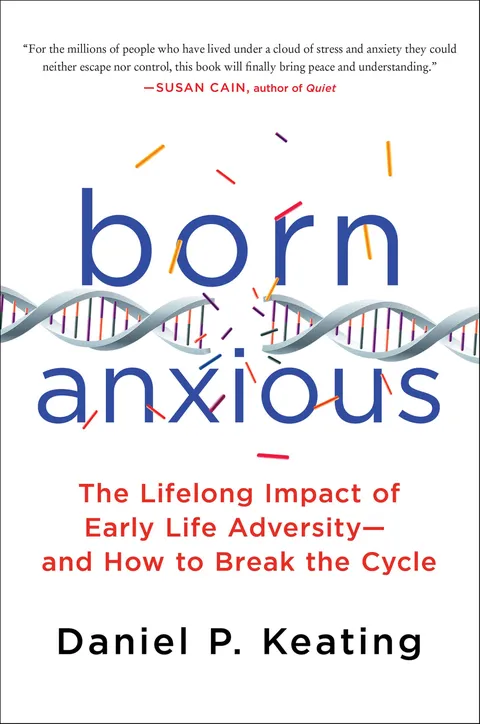
Born Anxious
The Lifelong Impact of Early Life Adversity—and How to Break the Cycle
Report an issue
Tell us what's wrong and we'll take a look.
Thanks – we got it. We'll review and follow up if needed.
Why are we the way we are? Why do some of us find it impossible to calm a quick temper or to shake anxiety? The debate has always been divided between nature and nurture, but as psychology professor Daniel P. Keating demonstrates in Born Anxious, new DNA science points to a third factor that allows us to inherit both the nature and the nurture of previous generations—with significant consequences. Born Anxious introduces a new word into our lexicon: "methylated." It's short for "epigenetic methylation," and it offers insight into behaviors we have all observed but never understood—the boss who goes ballistic at the slightest error; the infant who can't be calmed; the husband who can't fall asleep at night. In each case, because of an exposure to environmental adversity in utero or during the first year of life, a key stress system has been welded into the "on" position by the methylation process, predisposing the child's body to excessive levels of the stress hormone cortisol. The effect: lifelong, unrelenting stress and its consequences–from school failure to nerve-wracking relationships to early death. Early adversity happens in all levels of society but as income gaps widen, social inequality and fear of the future have become the new predators; in Born Anxious, Daniel P. Keating demonstrates how we can finally break the cycle.
Daniel P. Keating
Daniel A. Keating (DPhil, Oxford University) is professor of theology at Sacred Heart Major Seminary in Detroit, Michigan. He is the author or coauthor of several books, including The Adventure of Discipleship, Athanasius and His Legacy, The Nicene Creed, and two volumes in the successful Catholic Commentary on Sacred Scripture series: First and Second Peter, Jude and James, First, Second, and Third John.
More by Daniel P. Keating












Why Readwise Books?
Readwise Books is an ebook & audiobook platform that automatically logs how much you and your friends read, making it fun and easy to read more. Learn more →