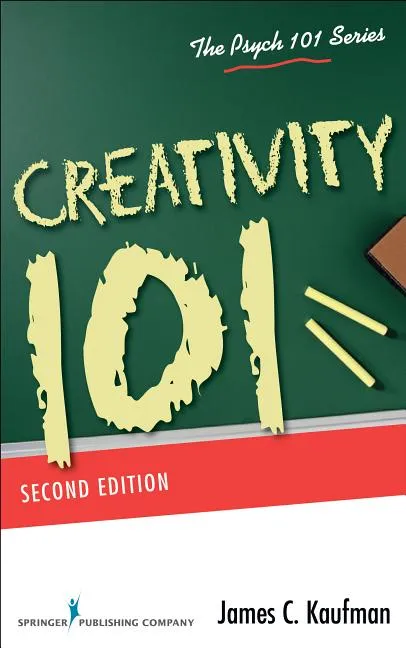
Creativity 101
Report an issue
Tell us what's wrong and we'll take a look.
Thanks – we got it. We'll review and follow up if needed.
What makes us creative? How can organizations, schools, or parents inspire people to be more creative? How do we even start to define the topic in thefirst place? Now in its second edition, this bestselling introductory text'Äîwritten by one of the world'Äôs leading experts on the psychology of creativity'Äîiscompletely updated and expanded to reflect the tremendous growth in this field. In a restructured, reader-friendly format, the text surveys the latesttheories and research to provide key information about what we know (and don'Äôt know) about creativity. It addresses how creativity operates both onindividual and on social/environmental levels, how it is defined and measured, and several hot debates in the field, such as creativity'Äôs uncertainrelationship to mental illness. Grounded in psychological research from clinical, industrial, social, cognitive, evolutionary, and developmentalperspectives, this text also draws on classic and current findings from neuroscience, business, education, engineering, and biology.
This much-praised book is an ideal brief and affordable text for courses on creativity in psychology, education, business, and other fields, as well ascross-disciplinary seminars and programs in creativity studies.
New to the Second Edition:
- Completely updated and expanded with new theories and frameworks and including the latest research
- Restructured to enhance flow of information and ease of use
- New coverage of how creativity can be improved at the level of the individual and the environment, measuring creativity, and creativity across cultures
James C Kaufman
Dr James C. Kaufman is a Professor of Educational Psychology at the Neag School of Education at the University of Connecticut. He is the author or editor of more than fifty books and has written more than four hundred papers, including theoretical contributions such as the Four-C model of creativity (with Ron Beghetto).
More by James C Kaufman


Why Readwise Books?
Readwise Books is an ebook & audiobook platform that automatically logs how much you and your friends read, making it fun and easy to read more. Learn more →