Report an issue
Tell us what's wrong and we'll take a look.
Thanks – we got it. We'll review and follow up if needed.
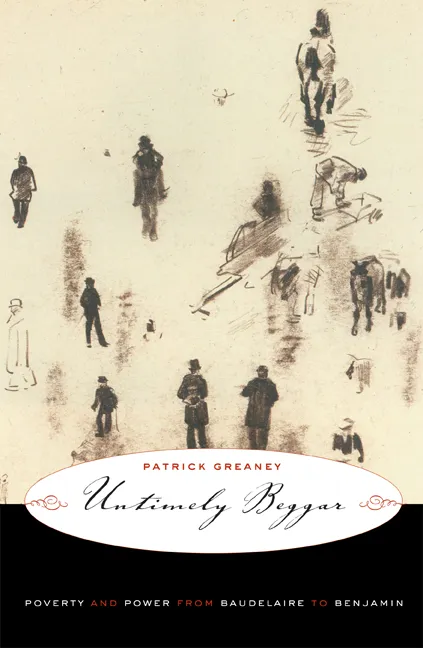
This highly original book takes as its starting point a central question for nineteenth- and twentieth-century literature and philosophy: how to represent the poor?
Covering the period from the publication of Les Fleurs du Mal in 1857 to the composition of Benjamin's final texts in the 1930s, Untimely Beggar investigates the coincidence of two modern literary and philosophical interests: representing the poor and representing potential. To take account of literature's relation to the poor, Patrick Greaney proposes the concept of impoverished writing, which withdraws from representing objects and registers the existence of power. By reducing itself to the indication of its own potential, by impoverishing itself, literary language attempts to engage and participate in the power of the poor.
This focus on impoverished language offers new perspectives on major French and German authors, including Marx, Nietzsche, Mallarmé, Rilke, and Brecht; and makes significant contributions to recent debates about power and potential in thinkers such as Agamben, Deleuze, Foucault, Hardt, and Negri. In doing so, Greaney offers significant insights into modernity's intense philosophical and literary interest in socioeconomic poverty.
Patrick Greaney is assistant professor of German studies at the University of Colorado, Boulder.
Patrick Greaney
Patrick Greaney is assistant professor of German and comparative literature at the University of Colorado at Boulder.
More by Patrick Greaney


Why Readwise Books?
Readwise Books is an ebook & audiobook platform that automatically logs how much you and your friends read, making it fun and easy to read more. Learn more →