Report an issue
Tell us what's wrong and we'll take a look.
Thanks – we got it. We'll review and follow up if needed.
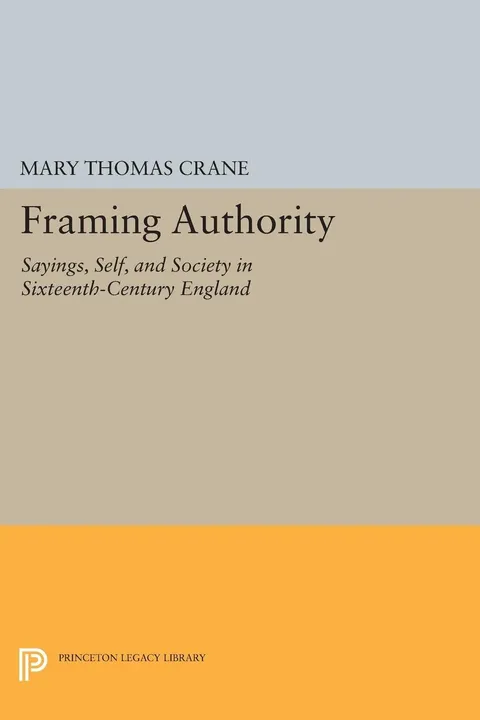
Writers in sixteenth-century England often kept commonplace books in which to jot down notable fragments encountered during reading or conversation, but few critics have fully appreciated the formative influence this activity had on humanism. Focusing on the discursive practices of "gathering" textual fragments and "framing" or forming, arranging, and assimilating them, Mary Crane shows how keeping commonplace books made up the English humanists' central transaction with antiquity and provided an influential model for authorial practice and authoritative self-fashioning. She thereby revises our perceptions of English humanism, revealing its emphasis on sayings, collectivism, shared resources, anonymous inscription, and balance of power--in contrast to an aristocratic mode of thought, which championed individualism, imperialism, and strong assertion of authorial voice.
Crane first explores the theory of gathering and framing as articulated in influential sixteenth-century logic and rhetoric texts and in the pedagogical theory with which they were linked in the humanist project. She then investigates the practice of humanist discourse through a series of texts that exemplify the notebook method of composition. These texts include school curricula, political and economic treatises (such as More's Utopia), contemporary biography, and collections of epigrams and poetic miscellanies.
Originally published in 1993.
The Princeton Legacy Library uses the latest print-on-demand technology to again make available previously out-of-print books from the distinguished backlist of Princeton University Press. These editions preserve the original texts of these important books while presenting them in durable paperback and hardcover editions. The goal of the Princeton Legacy Library is to vastly increase access to the rich scholarly heritage found in the thousands of books published by Princeton University Press since its founding in 1905.
Mary Thomas Crane
Mary Thomas Crane is the Thomas F. Rattigan Professor of English and director of the Institute for the Liberal Arts at Boston College. She works on early modern English literature and is the author of Framing Authority: Sayings, Self, and Society in Sixteenth-Century England (Princeton University Press, 1993), Shakespeare’s Brain: Reading with Cognitive Theory (Princeton University Press, 2000), and Losing Touch with Nature: Literature and the New Science in Sixteenth-Century England (Johns Hopkins University Press, 2014). She has taught the Enduring Question course “Revolutionary Media: How Reading Changes Us.”
More by Mary Thomas Crane


Why Readwise Books?
Readwise Books is an ebook & audiobook platform that automatically logs how much you and your friends read, making it fun and easy to read more. Learn more →